Lenormand
Yes or no oracle: the Lenormand Ring method and all 36 cards
Yes or no with Lenormand cards: the Ring method with 13 cards, what the four aces really are, and what each of the 36 cards answers.
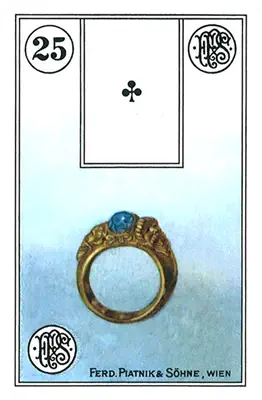
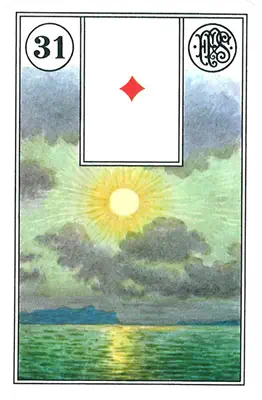
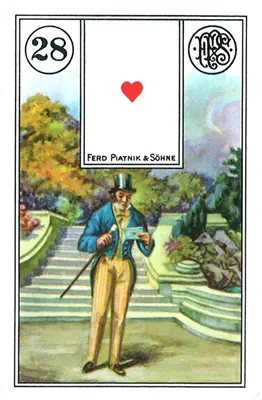
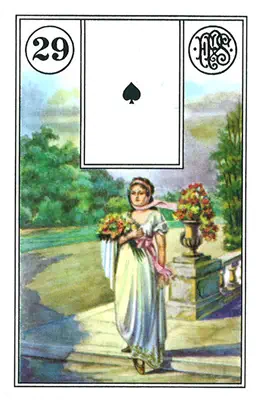
The Ring · The Sun · The Man · The Woman
A Lenormand yes or no reading comes in three forms: one card, three cards, or the Ring method, which lays out thirteen cards and answers yes if the Ring is among them. The “four aces” that many online readings mention are simply the four Lenormand cards that carry an ace: the Ring, the Man, the Woman and the Sun. This guide walks through the three methods step by step, gives a table of all 36 cards sorted into yes, no and nuanced, and offers one rule for asking a closed question without being trapped by the answer.
Key takeaways
- The Ring method: thirteen cards laid out, the Ring present means yes, absent means no. Where the Ring falls tells you how strong the yes is.
- The four aces are Lenormand cards, not another deck: the Ring (clubs), the Man (hearts), the Woman (spades) and the Sun (diamonds).
- Eighteen cards out of thirty-six say yes, nine say no and nine answer “it depends”: with a single card, the Lenormand says yes half the time.
- Three cards beat one: the center card gives the answer, its neighbors say “but” or “because”.
- One answer per question. You do not redraw; you write it down and reread it once the situation has resolved.
How does a yes or no reading work with Lenormand cards?
The Petit Lenormand has no printed “yes” card and no “no” card. Tradition solved the problem in two ways: by naming an answer card, the Ring, whose appearance in a layout counts as yes; and by sorting the 36 cards by tone, favorable, unfavorable or ambiguous, so that one or three cards can be read as an answer.
The two readings do not contradict each other; they serve different questions. The Ring method suits clear-cut questions: “will I sign?”, “will he call back?”. Reading by the tone of the cards suits questions where the “how” matters as much as the answer: “is it a good idea to accept?”.
The Lenormand is one of the few oracles where a yes or no makes sense at all. Its images describe situations, a letter, a contract, an obstacle, a departure, rather than inner states. A closed question gets a concrete answer here, where a guidance deck would answer with encouragement. If you are new to the deck, the Petit Lenormand guide covers the basics before you go further.
Most “yes or no oracles” online are random generators dressed up as a crystal ball: they return a yes or a no with no reference to your situation. The Lenormand works the other way round. Each of its 36 pictures shows something concrete, so the card that answers also tells you what the yes or the no is about: a letter, a delay, a person. That difference is what this whole guide is built on.
The Lenormand does not say yes or no. It shows the situation, and you are the one who reads a yes or a no in it.
The Ring method: thirteen cards, one answer
The Ring method is the most widespread form of the Lenormand yes or no. You shuffle the full deck while holding the question, cut, then turn over thirteen cards, a third of the deck. If the Ring is among them, the answer is yes; if it stays in the twenty-three cards you did not draw, the answer is no.
The protocol takes five moves:
- Write the question as one closed sentence, in the present tense, about you alone: “Do I sign this lease before the end of the month?”
- Shuffle the whole deck, then cut it once, with the left hand if you follow the old custom.
- Turn over thirteen cards, one at a time, in a line or in three rows of four plus one.
- Look for the Ring. Present: yes. Absent: no.
- Read its position if you want nuance. A Ring among the first five cards is a clear yes, and a quick one. Between the sixth and the ninth, a yes that still needs a move from you. In the last four, a late or conditional yes: read the two cards around it.
Why thirteen? Because it is a third of thirty-six, and that proportion sets the odds of a yes at 13 in 36, a little over one in three. This is deliberate: the method is built to say no more often than yes, which gives its yes a weight that a one-card reading does not have. Keep that figure in mind; we will come back to it.
The Ring’s neighbors set the tone of the yes. Ring next to the Sun or the Key: a yes that succeeds. Ring next to the Mountain: a yes that waits. Ring next to the Snake or the Fox: a yes whose terms deserve a second look before you celebrate.
The four aces of the Lenormand: what they really are
The four aces do not come from another deck. Every card of the Petit Lenormand carries a playing card, in a corner or a small cartouche: the 36 cards reproduce the 36 cards of a German deck, six through ace in four suits. The 1799 game the Lenormand descends from, Johann Kaspar Hechtel’s Spiel der Hoffnung from Nuremberg, already carried them so it could double as an ordinary deck of cards.
The four aces fall on four specific cards:
- the Ring, card 25, carries the ace of clubs;
- the Man, card 28, the ace of hearts;
- the Woman, card 29, the ace of spades;
- the Sun, card 31, the ace of diamonds.
This is no accident of printing. Aces are the strong cards of 32-card cartomancy, and the Lenormand gave them four strong images: commitment, the two people in the reading, and success. The “four aces” reading that many online tools offer comes from there. It circulates in several forms, with no reference text; here is the one we use, because it is readable and because it does not cheat.
The four-aces rule. Lay out thirteen cards as in the Ring method, then look at which aces came out.
- The Ring: yes, through commitment. Something gets concluded, signed, promised.
- The Sun: yes, plainly. The clearest answer in the deck; with the Ring, an unconditional yes.
- The Man or the Woman: the answer runs through a person, you or the other. The reading sends you back to the question: who has to say yes, really?
- No ace: no, or not now.
A word of honesty about the numbers. With four aces in the deck, thirteen cards show at least one of them 85 % of the time: an ace coming out is not an event. So the rule is not “yes if an ace shows up” but “which ace showed up”. The Ring and the Sun together, on the other hand, appear in only one reading out of eight: when that happens, you may take it as a yes.
What each card answers: the table of 36
For a one- or three-card reading, here are the 36 cards of the Petit Lenormand sorted by answer. The right-hand column says how the card answers, because a “no” from the Mountain and a “no” from the Coffin are not the same no. Each name links to the card’s full page.
| Card | Answer | What it says |
|---|---|---|
| 1. Rider | Yes | It is coming, and fast. News is on its way. |
| 2. Clover | Yes | A small, brief yes. Take it, it will not wait. |
| 3. Ship | Nuanced | Yes, but far away or later. Or it is drifting off. |
| 4. House | Yes | Yes, solid and without surprises. It holds. |
| 5. Tree | Nuanced | Yes, slowly. Count in months, not days. |
| 6. Clouds | No | The question is not clear. Rephrase before deciding. |
| 7. Snake | No | There is a detour; someone is interfering. Not in a straight line. |
| 8. Coffin | No | It is over, or it has to end. The clearest no in the deck. |
| 9. Bouquet | Yes | A pleasant yes. A gift, an invitation, a compliment. |
| 10. Scythe | No | A sudden, clean cut. If it is yes, it will be abrupt. |
| 11. Whip | No | Not without a fight, and not just once. |
| 12. Birds | Nuanced | A lot of talk about it. Yes if the question is a conversation. |
| 13. Child | Yes | Yes, but small, or only at the very start. It begins. |
| 14. Fox | No | Be wary. Something is calculated, not said. |
| 15. Bear | Yes | Yes, with force behind it: support, money. |
| 16. Stars | Yes | Yes, and in the right direction. Hold your course. |
| 17. Stork | Yes | Yes, through a change. Nothing will stay as it was. |
| 18. Dog | Yes | A reliable yes. You can count on it. |
| 19. Tower | Nuanced | Yes, through official channels. Slow, and you will carry it alone. |
| 20. Garden | Yes | Yes, and it will show. Others are involved. |
| 21. Mountain | No | Not now. The obstacle is real, not final. |
| 22. Crossroads | Nuanced | Your choice. The reading is waiting for your decision. |
| 23. Mice | No | It is wearing away. What exists is losing value. |
| 24. Heart | Yes | Yes, from the heart. The feeling is there. |
| 25. Ring | Yes | Yes, through commitment. It gets concluded, signed, promised. |
| 26. Book | Nuanced | You do not know everything. The answer exists but is not visible yet. |
| 27. Letter | Nuanced | The answer will come in writing. Its tone depends on the card next to it. |
| 28. Man | Nuanced | The answer runs through a man, or through you. |
| 29. Woman | Nuanced | The answer runs through a woman, or through you. |
| 30. Lily | Yes | A calm, mature yes. In time. |
| 31. Sun | Yes | Yes, plainly. The clearest answer in the deck. |
| 32. Moon | Yes | Yes, and you will be recognized for it. In cycles. |
| 33. Key | Yes | Yes, for certain. The door opens. |
| 34. Fish | Yes | Yes, and it flows: money, resources, movement. |
| 35. Anchor | Yes | A lasting yes. It holds, but it will not move again. |
| 36. Cross | No | No, and it is heavy. What you carry is not up for negotiation. |
The count speaks for itself: eighteen yes, nine no, nine nuanced. With a single card the Lenormand answers yes half the time and no a quarter of the time. That is generous, and it is why a one-card reading is for taking the temperature, not for deciding. To decide, move to three cards.
The nine nuanced cards are the most interesting in the deck. They do not refuse to answer; they hand the question back. The Crossroads says the answer depends on a choice you have not made yet. The Book says you are missing a piece of information. The Man and the Woman say the answer belongs to someone. When one of them lands in the center of a reading, the right response is not to redraw but to go find what is missing.
Adding nuance with three cards
The three-card reading is the Lenormand’s reference format, and it is also the best yes or no for a question that matters. You read the center card as the answer, and its two neighbors as the “because” and the “but”. The majority rule, two cards out of three pointing the same way, is only needed when the center is nuanced.
To lay it out: write the question, shuffle, draw three cards from left to right. Read the center first, with the table above. Then the left card, which says where the answer comes from, and the right card, which says where it is heading. If all three cards are nuanced, the deck is telling you the question is not ripe: come back to it in a week.
Here is an example built to show the method, and presented as such. Question: “Do I sign this contract before the end of the year?” Cards: Letter – Ring – Mountain.
The center answers yes: the Ring, the commitment, the contract itself. On the left, the Letter says where that yes comes from: the document exists, it is circulating, it may already be drafted. On the right, the Mountain says where it is heading: a delay. Full reading: yes, the agreement is there and so is the paperwork, but not before the end of the year. The calendar is blocking, not the will. That is neither a yes nor a no; it is a useful answer, one that says what to do: follow up on the date, not on the substance.
The Ring method would have given a flat yes or a flat no on the same question. Both readings are right; the three-card one says more.
What about the Belline or the Triade?
The Belline oracle has no answer card like the Ring. You read yes or no by planetary family: the cards of the Sun, Jupiter and Venus say yes, those of Saturn say no or delay, those of Mars say yes but not without friction, those of Mercury make the answer depend on a piece of information, and those of the Moon say nothing is clear yet. The Blue Card, with no image, is the only Belline card that truly refuses to answer: the question has no answer today. If the question is about love, Belline love cards covers the cards involved in detail.
The Triade oracle lends itself less to yes or no: its cards describe states and forces more than situations. Draw three cards and read the tone of the center card, without looking for an answer card that does not exist in this deck.
If you are choosing between decks for this kind of question, the Lenormand remains the most direct: it is the only one of the three where tradition appointed a card to say yes. Our oracle comparison covers what sets the site’s six decks apart.
Why yes or no is a trap, and how to ask it anyway
The author of this guide is a psychotherapeutic practitioner, and this is the part he most wanted to write. Yes or no is the most requested reading because it promises to cut things short, and the one that disappoints most, for three reasons worth knowing before you shuffle.
A closed question hides an open one. “Will he come back?” means “what do I do with my waiting?”. “Do I take this job?” means “what am I afraid of losing if I say yes?”. The cards answer the first; the second is the one occupying you. Write both down before you draw: often, the second one does not need cards.
Yes is cheap. You have seen the figures: half the deck says yes, the Ring method says it one time in three, and an ace almost always shows up. An oracle that says yes easily is not an oracle that lies; it is an oracle read badly. The value of the reading is never in the yes or the no; it is in the card that says how.
We keep the answer that suits us. That is confirmation bias, and nobody is immune. A no we dislike becomes “the question was badly worded”; a yes we like becomes a certainty. The remedy is simple and a little austere: one question, one draw, the answer written down with the date. You reread it in a month, once the situation has decided. That is the only moment a yes or no reading teaches anything, and what it teaches is about you.
How do you ask it anyway? Ask it as a rehearsal of the decision. Before turning the cards, tell yourself what you would do if it were yes, then if it were no. If both answers leave you with the same action, you do not need the reading; you need to act. If one of the two brings relief, you have just learned what you want; the reading will only have been a pretext for telling yourself so, and that is the most honest use of the cards.
And if the question pushing you toward a yes or no is heavy, a breakup, your health, a debt, a reading replaces neither someone close to you nor a professional. It can open the conversation; it must not close it.
Ask your question
A closed question written in the present tense, three cards, the table of 36 to read the center, and a single answer that you note down with the date. That is the whole Lenormand yes or no, and it is already a lot.
Draw your three cards on OracleNova, it is free, and keep the reading in your journal to reread the answer once the situation has resolved: do my Lenormand yes or no reading. To go beyond yes or no, the Grand Tableau reads a whole situation in 36 cards, and if the question touches a relationship, the cards that speak of love complete the table in this article.
Sources
- “Lenormand cards”, Wikipedia: correspondence between the 36 cards and the playing cards (ace of clubs on the Ring, ace of hearts on the Man, ace of spades on the Woman, ace of diamonds on the Sun); origin in Johann Kaspar Hechtel’s Spiel der Hoffnung, Nuremberg, circa 1799. en.wikipedia.org
- Sabrina Guilbert, Le Petit Lenormand, Éditions Leduc (online excerpt, in French): the 1799 German game published in Nuremberg by Gustav Philipp Jakob Bieling, with playing cards shown on the original cards. editionsleduc.com
- The probabilities quoted (13 in 36 for the Ring, 85 % for at least one ace among thirteen cards, one reading in eight for the Ring and the Sun together) are combinatorial calculations on a 36-card deck drawn without replacement.
Frequently Asked Questions
→Which Lenormand card means yes?
The Ring (card 25) is the traditional “yes” card: in the thirteen-card method, its presence means yes and its absence means no. In a one- or three-card reading, the Sun, the Key, the Clover, the Bouquet, the Heart and the Stars all say yes without reservation; the Key and the Sun give the clearest yes in the deck.
→Which Lenormand cards mean no?
Nine cards answer no: the Coffin, the Cross, the Mountain, the Mice, the Scythe, the Whip, the Snake, the Fox and the Clouds. They do not all say the same no. The Mountain says “not now”, the Coffin says “it is over”, the Clouds say “the question is not clear yet”. Read the nuance before you close the subject.
→What are the four aces of the Lenormand?
Every card in the Petit Lenormand carries a small playing card. The four aces fall on the Ring (ace of clubs), the Man (ace of hearts), the Woman (ace of spades) and the Sun (ace of diamonds). A “four aces” reading treats these as the strong answers of the deck: the Ring and the Sun for yes, the Man and the Woman to show who the answer depends on.
→How many cards do you draw for a Lenormand yes or no?
Three formats exist. One card for a quick answer, read with the table of 36. Three cards for a nuanced answer, with the center card carrying the verdict. Thirteen cards for the Ring method, the classic one: you lay out a third of the deck and look for the Ring among those cards.
→Can I draw again if I don’t like the answer?
No, and that is the most useful rule in this guide. A second draw on the same question does not add information; it teaches you to ignore the first answer. Write down the answer, the date and how it made you feel. If the situation truly changes, ask again, in different words, at least a few days later.
→Can I do a free Lenormand yes or no reading online?
Yes. On OracleNova the three-card Lenormand reading is free, with the meaning of each card shown under the spread. Ask a closed question, draw three cards and read them with the yes / no / nuanced table in this article. Keep the reading in your journal so you can check the answer once the situation has resolved.
→Is an online yes or no oracle the same as a Lenormand reading?
No. Most online yes or no oracles are random generators: they return an answer with no link to your situation. A Lenormand reading answers through a picture, so the card that says yes or no also says what it is about, a letter, a delay, a person. That is what makes the answer usable rather than just reassuring or alarming.
Read next
Lenormand
Lenormand year ahead spread for 2027: 12 cards, 12 months
Your 2027 year ahead spread with the Lenormand: 12 cards for 12 months, a card of the year, a reading grid for all 36 cards and a worked example.
Read article →Lenormand
Lenormand Grand Tableau: The 36-Card Method Explained
Learn the Grand Tableau Lenormand step by step: 9×4 layout, significator, reading by houses, distance and direction. The queen-method of Lenormand to read a whole life in a single spread.
Read article →