Lenormand
Lenormand Grand Tableau: The 36-Card Method Explained
Learn the Grand Tableau Lenormand step by step: 9×4 layout, significator, reading by houses, distance and direction. The queen-method of Lenormand to read a whole life in a single spread.
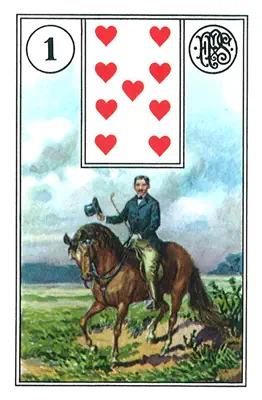
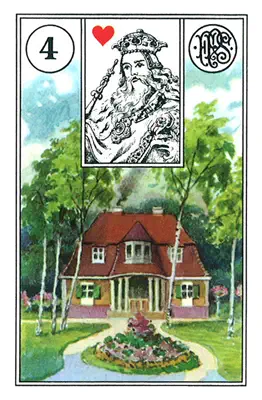
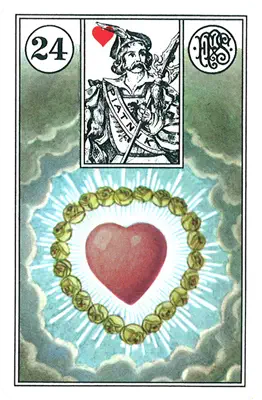
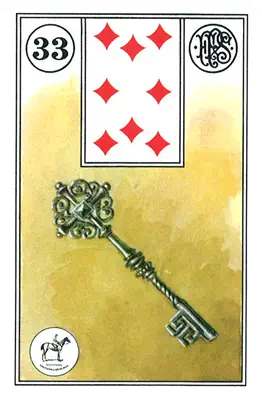
The Rider · The House · The Heart · The Key
The Grand Tableau is the queen-method of Lenormand: a single spread using all 36 cards of the deck to describe an entire person's situation — past, present, future, relationships, finances, health, spirituality. It's also the most complex reading to do correctly. This guide breaks down the procedure step by step, from possible layouts to reading by houses and distances, so you can execute your first Grand Tableau without getting lost.
Why «grand» tableau
Where most Lenormand spreads use 3, 5, or 9 cards, the Grand Tableau uses all 36 cards of the deck at once. Every card is on the table, in a fixed layout, and each position carries meaning (the «house»). You then read the cards around the querent's significator to reconstruct their situation.
It's the maximum reading in Lenormand: no other method delivers as much information in a single spread. It's also the one demanding the most practice to avoid drowning in data. To first explore the deck, see the 36 Lenormand cards or the general spreads guide.
The two main layouts
There are two classic ways to lay out the 36 cards on the table. Pick one and stick to it — mixing conventions blurs the reading.
Layout 8×4+4 (European tradition): 8 columns × 4 rows = 32 cards, plus 4 cards centered at the bottom (positions 33 to 36). It's the oldest version, inherited from 19th-century German cartomancy. Visually, you have a wide rectangle topped by a small bottom row. The bottom row is read as a «commentary» on the first 32 cards.
Layout 9×4 (symmetric grand tableau): 9 columns × 4 rows = 36 cards in a perfect rectangle. It's the modern version, easier to analyze by rows and columns because each row has the same length. Most contemporary card readers prefer this layout for its readability.
For this guide, we'll use the 9×4 — simpler for beginners, and usable without adaptation for the mirroring techniques covered later.
Step 1: choose your significator
Before casting, choose the card representing the querent.
- Man (#28): male significator
- Woman (#29): female significator
If reading for yourself, take the card matching your gender. If reading for someone else, take theirs. For a couple reading, you can follow two significators in parallel within the same tableau.
This card isn't set aside: it stays in the deck, shuffled with the other 35, and you watch where it falls in the tableau once laid out. Its position is the anchor of the entire interpretation.
Step 2: cast and lay out the 36 cards
Shuffle the deck thoroughly while focused on your question (or on your life broadly if doing a period Grand Tableau). Lay the 36 cards face down in rows of 9, left to right and top to bottom.
Then flip all the cards at once. You get a tableau of 9 columns × 4 rows — 36 cards visible simultaneously. Positions are numbered 1 (top-left) to 36 (bottom-right).
[1]  [2]  [3]  [4]  [5]  [6]  [7]  [8]  [9]
[10] [11] [12] [13] [14] [15] [16] [17] [18]
[19] [20] [21] [22] [23] [24] [25] [26] [27]
[28] [29] [30] [31] [32] [33] [34] [35] [36]
Step 3: locate the significator
Visually find your Man or Woman in the tableau. Note its position. It's the center of your reading — everything that follows organizes around it.
Reading by houses (positions)
In the Lenormand tradition, each position has a fixed meaning, like an astrological «house». The card falling at that position influences the corresponding domain.
The positions correspond to the 36 cards themselves:
- Position 1 = house of the Rider → arrivals, news, messages
- Position 4 = house of the House → home, family, security
- Position 9 = house of the Bouquet → gifts, joys, surprises
- Position 24 = house of the Heart → love, emotions
- Position 25 = house of the Ring → commitments, contracts
- Position 28 = house of the Man → male identity
- Position 29 = house of the Woman → female identity
- Position 33 = house of the Key → resolutions, openings, success
And so on for all 36 positions. When the Heart falls on position 25 (house of the Ring), it speaks of a love leading to commitment. When the Cross (#36) falls on position 4 (house of the House), a weight presses on the home.
For beginners, reading by houses is advanced. Focus first on the directional reading below, more immediate.
Directional reading around the significator
This technique is the core of the Grand Tableau for beginners. Once you've spotted your significator, read cards along four axes.
In front (to the right of the significator, in the Western reading direction): what's approaching, the near future. If the personal card faces right (like the Woman looking right), everything in that direction comes toward her.
Behind (to the left of the significator): the past, what's moving away, residual influences. A difficult card behind is less concerning than a difficult card in front.
Above: what's conscious, what the person thinks, explicit plans, mental sphere.
Below: what's unconscious, what weighs, emotional or material foundations, what isn't articulated.
Quick reading: the 4 cards immediately neighboring the significator (top, bottom, left, right) describe the active forces around the querent right now. If you read only that, you'd already have 80 % of the spread.
Distance between cards: near, medium, far
The closer a card is to the significator, the stronger and more present its influence. The further it is, the more remote in time or weaker in intensity.
Practical convention:
- 0 to 2 cells = immediate present, coming weeks
- 3 to 5 cells = coming months
- 6+ cells = distant horizon, several months to years
This logic lets you roughly date events. The Rider 2 cells in front of the Man = a piece of news in 2 weeks to 2 months. The Stork at 5 cells = a phase change in several months.
The corners of the tableau
The four corners of the Grand Tableau carry special meaning. The cards there describe overarching influences on the reading.
- Top-left corner (position 1): distant past, origin of the situation
- Top-right corner (position 9): spiritual or intellectual culmination
- Bottom-left corner (position 28): foundations, material root
- Bottom-right corner (position 36): final outcome, what everything tends toward
When the Sun falls at the bottom-right corner, the tableau points to a happy ending. When the Cross falls at that same position, watch out: a weight to carry before reaching resolution.
Rows and columns
Each row tells a layer of the situation, and each column tells a temporal axis.
The 4 rows:
- Row 1 (top): conscious, mental, appearances
- Row 2: daily life, active relationships
- Row 3: deep emotional, felt
- Row 4 (bottom): foundations, what everything rests on
The 9 columns (in 9×4):
- Columns 1–3 (left): the past, what's declining
- Columns 4–6 (center): the present
- Columns 7–9 (right): the future, what's emerging
The card at the exact center of the tableau (position 23, middle of row 3) is the pivot card: the central stake, the theme of the whole reading.
3 beginner mistakes to avoid
Trying to read everything at once. The Grand Tableau has 36 cards, 36 houses, distances, directions, corners, rows, columns. If you try to integrate it all simultaneously, you drown. Start with: (1) significator + 4 neighbors, (2) the 4 corners, (3) the significator's row. That's enough for 90 % of a reading.
Ignoring the significator. Classic mistake: reading cards one by one in order 1, 2, 3… without regard to the significator's position. The Grand Tableau is NOT a linear sequence — it's a system organized around a central point. Without a significator, it's just an array of cards.
Casting too often. The Grand Tableau is dense. Doing it twice a week for the same person dilutes signals and tires the oracle. Space them out: one Grand Tableau per month for yourself, one every 3 months for a strategic question. In between, use 3- or 5-card spreads for everyday questions.
To go further
Once the basic method is mastered, several advanced techniques enrich the reading:
- The mirror: the symmetric card to the significator relative to the tableau center tells its shadow, what it doesn't see.
- Knighting: jump in an L-shape from the significator (like chess) to reveal hidden influences.
- The extended grand tableau: add «godparent» cards (Man and Woman, House, Heart, Key) as secondary reading points.
These techniques unfold over time. Master directional reading + corners + key houses first — that's already enough material for years of practice.
In short
The Grand Tableau uses all 36 Lenormand cards in a fixed layout (9×4 or 8×4+4) to produce an exhaustive reading of a person's situation. The significator (Man or Woman) is its pivot. Reading organizes around it along four axes (front, back, above, below), with additional techniques (houses, distances, corners, rows/columns) enriching the interpretation.
Like any deep method, the Grand Tableau is learned through practice. Cast one on yourself, photograph it, re-read it a week later to see how the distance shifts your interpretation. That's how the cartomancer's eye develops.
For shorter methods, see the Lenormand spreads guide. To explore card combinations two by two, see Lenormand combinations.
Going further
If this guide helped, you'll likely enjoy our related deep-dive: Lenormand Love Cards: Top 9 Most Positive in a Reading — a companion piece that picks up where this one ends.
Browse every essay in the Articles & Guides hub to keep going.
Frequently Asked Questions
→What's the difference between 8×4+4 and 9×4 layouts?
The 8×4+4 layout arranges cards in 8 columns × 4 rows = 32 cards, plus 4 centered cards at the bottom. It's the classic «European tradition» version. The 9×4 lays all 36 cards in 9 columns × 4 rows with no extras — the «symmetric grand tableau», easier to analyze by rows and columns. Both give valid results; the choice is a matter of school.
→How do I choose between the Man and Woman card as significator?
Use the card matching the querent's gender: Man (#28) for a male reading, Woman (#29) for a female reading. If the querent doesn't identify with either, choose freely based on resonance. For a reading on a third party (a partner, for example), use that person's significator. A reading can follow two significators in parallel (couple, parent-child).
→What if the significator falls in a corner of the tableau?
That has meaning in itself. Significator in the top-left = anchored in the past, in memories; top-right = facing the future, ambitions; bottom-left = roots, family, foundations; bottom-right = outcome, where everything tends. In every case, read the cards in immediate proximity (the 4 neighbors) with special attention — they describe the current state of the querent.
→How long does a Grand Tableau take?
Count 5 minutes for the cast and layout, then 30 to 60 minutes for a full reading if you want everything (houses, distances, rows, columns, corners, mirrors). For a quick reading centered on the significator and direct neighbors, 15 minutes is enough. That's what makes the Grand Tableau rich: you can read it at multiple depths of analysis depending on time available.
→Can you do a Grand Tableau for yourself?
Yes, but it's the hardest exercise in cartomancy — emotional distance is rare when you're both judge and jury. Tips: cast in the morning on a wide question («How is my situation looking right now?»), photograph the tableau to re-read later with detachment, and don't pull more than one Grand Tableau per month for yourself. A weekly cast is obsession, not consultation.