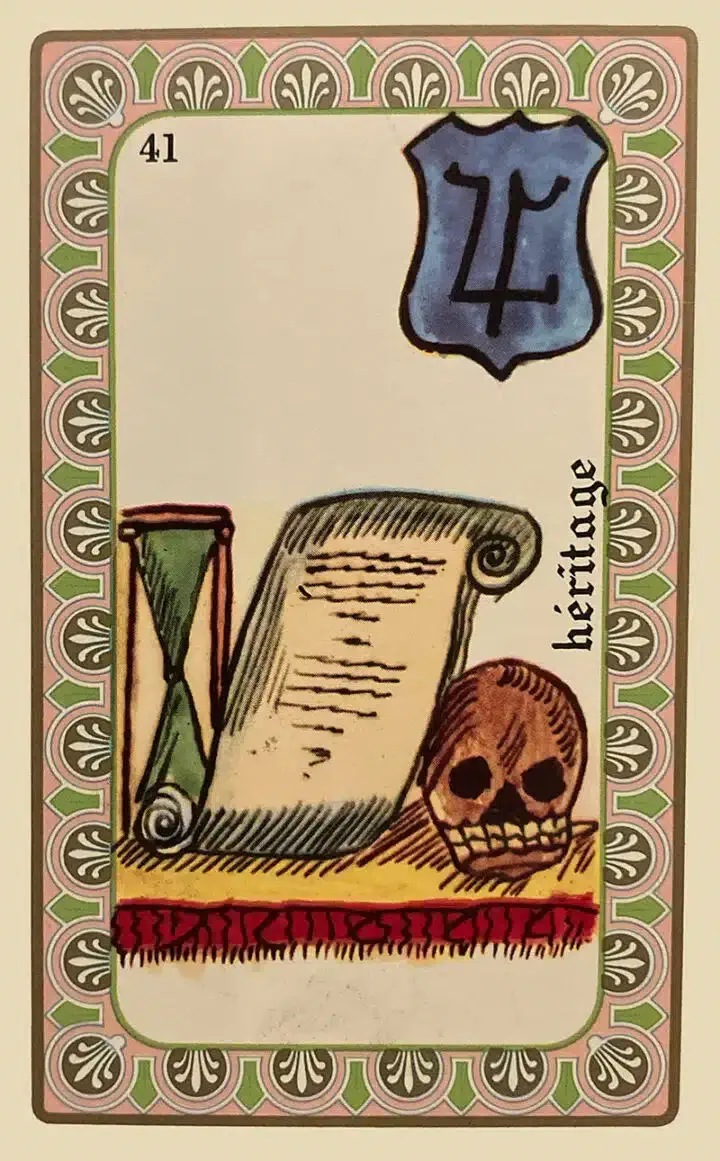
Belline · Card #41 · ♄ Saturn
Inheritance — Belline
“What passes from one generation to the next, the legacy received, Saturn's long memory made material”
Inheritance is Saturn (♄) in his most temporal and transgenerational expression — the planet of time and continuity governing the process by which what one generation has built, earned, created, or been passes to the next. Saturn is the record-keeper, the archivist, the one who ensures that what has been achieved is not lost when the individual who achieved it passes from the stage. In the Belline tradition, inheritance encompasses the full spectrum of what passes between generations: material (property, money, objects of value), biological (genetic traits, constitutional tendencies, predispositions to certain conditions), psychological (family patterns, cultural values, emotional templates), and spiritual (a tradition of practice, a family's relationship with the sacred, the accumulated wisdom of a lineage). All of these are Saturn's inheritance — the long memory of time made concrete in what each generation receives and passes on. The card carries Saturn's ambivalence: inheritance can be gift (wealth, talent, opportunity) or burden (debt, trauma, obligation). Often it is both simultaneously — the family estate that brings resources and complications in equal measure, the psychological inheritance that includes both strengths and wounds.
General Meaning
Inheritance in a reading signals that questions of legacy, succession, and the transmission of what has been built are central to the querent's current situation. At its most literal, the card indicates a material inheritance — property, money, or possessions being transmitted through a will or estate — either received or about to be received, or contested and uncertain. Beyond material transmission, the card raises questions about all forms of inheritance: the talents and tendencies that came with the family of origin, the cultural values absorbed from the lineage, the psychological patterns that were modelled and transmitted before the querent was old enough to choose. What has the querent inherited, and from whom? What is being honoured, what is being questioned, and what is being consciously transformed? Inheritance can also refer to what the querent will leave — the legacy being built through current choices and actions, the what-will-I-pass-on question that becomes increasingly pressing as adulthood deepens and one begins to be the older generation rather than the younger.
Positive aspects
In a positive position, Inheritance indicates a genuine windfall through legacy — property, money, or other material assets are coming to the querent through inheritance or the equivalent. This is often literal: a bequest from a deceased relative, a family property being transferred, a professional inheritance (being taken on as someone's successor in a business or artistic tradition). The card can also indicate a positive non-material inheritance: the querent discovers that they have received remarkable gifts from their lineage — talents, values, opportunities that they are now in a position to recognise and deploy. The family history, examined more closely, reveals resources and strengths that were not previously visible.
Challenging aspects
When Inheritance appears in difficult positions, the legacy is complicated, contested, or primarily a burden. Family conflict over an estate; unexpected debts or obligations that come with an inheritance; the discovery that what seemed like a gift is actually a burden in another form. Can also indicate the inheritance of psychological wounds — patterns from the family of origin that are sabotaging the querent's present life.
Meaning by Domain
Love
The inheritance dimension of romantic relationships: the patterns learned in childhood that show up in adult partnerships, the family expectations around marriage and family, the financial dimension of inheritance as it affects a partnership (whose money is whose, whose family is owed what).
Career
Professional inheritance: being groomed as a successor, inheriting a business or practice, receiving a professional legacy from a mentor. The career shaped by family tradition or expectation.
Health
Genetic inheritance: predispositions to certain conditions, constitutional tendencies, the body type and metabolic patterns that came with the family of origin. Understanding the health inheritance allows for more intelligent preventive care.
Spirituality
Ancestral spiritual inheritance: the tradition of practice, the relationship with the sacred, the accumulated wisdom and wounds of a spiritual lineage. Working consciously with this inheritance — honouring what is genuine and transforming what is harmful.
Finances
Material inheritance in all its forms: property, money, investments, business interests, debts. The financial consequences of a death in the family, the economics of probate, the strategic management of inherited assets.
Inheritance in Combinations
Inheritance gains specificity from what accompanies it. With Gifts (11), the inheritance is generous, unexpected, and unambiguously positive — a true gift from the previous generation. With Betrayal (12) or Lawsuit (34), the inheritance is contested — family conflict, legal proceedings, or hidden debts and obligations complicate the transmission. With Change (19), the inheritance triggers or accompanies a significant life transition. With Penates (17), the family home specifically is the inheritance in question. With Wisdom (44), the querent is ready to receive the inheritance — including its psychological dimension — with clear eyes and mature integration. With Ruin (52), the inheritance includes debts or liabilities that contribute to financial difficulty.
Key combinations
Historical Note
Saturn's governance of Inheritance is among the most logically consistent attributions in the entire Belline system. Saturn governs time, continuity, what endures, and the long arc of consequence across generations. Inheritance is quintessentially Saturnian: it is what time produces, what endures beyond individual life, and what the previous generation bequeaths to the next through Saturn's careful record-keeping. In 19th-century France, inheritance law was enormously important and contested. The Code Napoléon (1804) had significantly changed inheritance rules, and the resulting debates about succession, property rights, and the distribution of family wealth between children generated constant social tension and cartomantic consultation. The Inheritance card was among the most practically consequential in the Belline deck for the society it served.
FAQ
Does Inheritance always mean someone has died or will die?
Not necessarily — while literal inheritance through a will is one of its most common readings, the card can also indicate inheritance that happens during a living person's lifetime (gifts of property or money from parents), professional inheritance (being named a successor), or psychological inheritance (recognising what you have received from your family).
Can Inheritance appear when the querent is thinking about their own legacy?
Yes — in certain positions the card addresses what the querent will pass on rather than what they have received: the legacy being built, the succession being prepared for, the question of what will outlast the querent's individual life.
What does Inheritance indicate about psychological or emotional patterns received from family?
It raises the question honestly and with appropriate gravity. The card acknowledges that psychological inheritance is real — that the family patterns, emotional templates, and relational habits absorbed in childhood are a genuine inheritance that shapes adult life profoundly. The question the card asks is: is this inheritance being honoured, examined, and where necessary, consciously transformed?
Why does Saturn rule Inheritance rather than Jupiter, who rules abundance?
Jupiter rules abundance as it is currently experienced — the generous provision of the present moment. Saturn rules what accumulates across time and is transmitted through generations. Inheritance is inherently temporal and transgenerational — it is the long game of Saturn, not the immediate generosity of Jupiter. Jupiter may give; Saturn preserves and transmits what has been given across time.
For advanced readers: how does the doctrine of Saturn's exaltation in Libra affect the Inheritance card?
Saturn exalted in Libra (the sign of balance, justice, and formal relationship) suggests that the best inheritance — both received and transmitted — is conducted with scrupulous fairness and in accordance with clearly established, mutually acknowledged agreements. The most Saturnine wisdom in inheritance situations is therefore: make the will clear, the succession explicit, and the terms agreed by all parties. The disputes that arise in estates are almost always the result of ambiguity, secrecy, or the assumption that fairness is obvious when it is not.