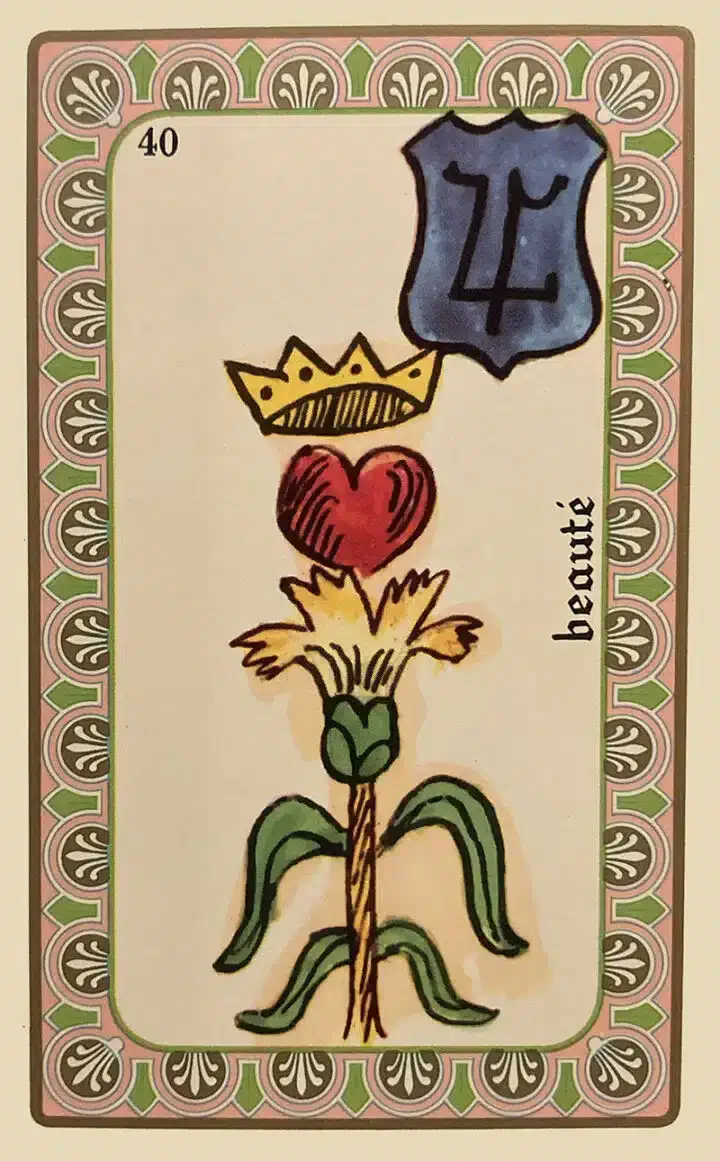
Belline · Card #40 · ♀ Venus
Beauty — Belline
“The world perceived in its fullness, the aesthetic dimension of life, Venus transfiguring the ordinary”
Beauty is Venus (♀) in her most purely aesthetic dimension — the planet not as relationship (Love, Union) or pleasure (Pleasures) or gift (Gifts) but as the principle of beauty itself: the capacity of the world and of human creation to be genuinely beautiful, and the human capacity to perceive and be transformed by that beauty. In the Neo-Platonic tradition that shapes the Belline esoteric framework, Beauty is one of the three divine transcendentals — the Good, the True, and the Beautiful — each of which is an aspect of the ultimate reality. To encounter genuine beauty is therefore to touch something sacred: a face in which the divine shines through, a piece of music that opens the heart to what is beyond ordinary perception, a landscape that stops the chattering mind and produces a moment of pure presence. The card governs physical appearance and personal presentation (Venus's immediate domain), the arts in all their forms, the aesthetic dimension of professional and personal environments, and the transformative effect that deliberate attention to beauty can have on the quality of life. It also speaks to the capacity for aesthetic experience — the ability to see the world as beautiful — which is itself a form of spiritual development.
General Meaning
Beauty in a reading invites attention to the aesthetic dimension of the querent's situation — to appearance, to how things look and feel, to the role that art, grace, and visual or sensory pleasure play in the current circumstances. At its most literal, the card can indicate personal attractiveness as an important factor in the situation, or the role of art, design, or aesthetic work in the querent's professional or personal life. At a deeper level, the card asks: are you allowing yourself to perceive and be nourished by beauty? Is the environment you inhabit beautiful enough to sustain the kind of human flourishing that quality of life requires? Is the work you are doing oriented toward something beautiful — something that will be genuinely lovely to behold or experience? Beauty also speaks to personal presentation: the way one appears to the world, the investment made in grooming, dress, and the careful curation of one's outer appearance as an expression of inner value. This is not vanity but Venus's legitimate domain: looking and feeling beautiful is part of a life well lived.
Positive aspects
In a positive position, Beauty signals a period of aesthetic flourishing — creative work of exceptional quality, a personal appearance that is genuinely beautiful and well-received, an environment that nourishes through its loveliness, or the experience of falling genuinely in love with beauty in some form. The arts prosper; the creative vision is clear and well-executed; the world seems more beautiful than it has in some time. For artists, designers, musicians, writers, and anyone whose work involves the creation of beautiful things, this card is the oracle's most direct endorsement: the work is genuinely beautiful, and the world will respond to it.
Challenging aspects
When Beauty appears in difficult positions, it can indicate superficiality — the Venusian preoccupation with outer appearance that neglects inner substance, the seductive surface that conceals hollow depth, or the investment in looking good rather than being good. The shadow of Beauty is vanity, and vanity is the perversion of a genuine human need for aesthetic dignity. The card can also indicate that beauty is being missed — that the querent is moving through life without experiencing the aesthetic richness that their nature requires, surviving functionally but not flourishing aesthetically. The soul is hungry for what is beautiful.
Meaning by Domain
Love
Physical attraction and its role in a romantic connection. A partner who is physically beautiful or who has an aesthetic sensibility that deeply resonates with the querent's. The role of beauty — shared aesthetic values, attention to the beauty of the domestic environment — in sustaining a relationship's vitality.
Career
The arts, design, fashion, beauty industry, cosmetics, interior design, architecture, film, music, literature, photography. Any profession whose product is something beautiful. Creative professions in which the aesthetic dimension is central.
Health
The health dimension of beauty: the relationship between physical health and attractive appearance, the importance of beauty as a health resource (the documented effects of exposure to natural beauty on mental health, the healing power of art therapy). Care for the physical body as an aesthetic practice.
Spirituality
Beauty as a spiritual path — the via pulchritudinis (path of beauty) in which the encounter with genuine beauty is understood as an encounter with the sacred. Aesthetic experience as a form of prayer. The arts as spiritual practice.
Finances
Income through beauty-related fields. Investment in aesthetics as a business strategy — the premium that beautiful design, beautiful products, and beautiful environments command. The economic value of beauty in the marketplace.
Beauty in Combinations
Beauty elevates and aestheticises whatever it accompanies. With Love (30), the romance has a strongly aesthetic dimension — both parties are beautiful to each other in the fullest sense. With Success (6), the achievement is also beautiful in its execution — the work that is both effective and excellent in form. With Money (20), income through beauty-related fields is strongly indicated. With Betrayal (12), Beauty's shadow: the beautiful exterior concealing a harmful interior — the seductive deceiver who uses attractiveness as a tool of manipulation. With Malice (33), a person who appears beautiful or charming while harbouring genuine ill will. With Illness (18), the card can indicate that beauty-related practices — art therapy, exposure to nature's beauty, music — are part of the healing path.
Key combinations
Historical Note
Venus as the goddess of beauty is the most ancient and universal of all her attributes. From the earliest fertility figurines of Paleolithic Europe through the Venus de Milo to Botticelli's Primavera and beyond, the beauty-principle has been understood as feminine, Venusian, and divine. Edmond de Grosmont's inclusion of a dedicated Beauty card in the Belline oracle reflects the 19th century's intense preoccupation with aesthetic theory. The Romantic and later Symbolist movements were engaged in extended philosophical investigation of what beauty is and how it operates in human life. The Belline card enters this conversation: beauty is not superficial decoration but one of the deep structures of a life well-lived.
FAQ
Does Beauty only refer to physical attractiveness?
Physical attractiveness is one of its domains, but beauty in the Belline tradition is much broader: the beauty of art, music, and literature; the beauty of a well-made thing; the beauty of a character that shines through a face; the beauty of a natural landscape; the beauty of a mathematical proof or a philosophical argument. Physical beauty is the most immediate Venusian expression, but not the only one.
Can Beauty appear in a reading about a man?
Absolutely — though the traditional Venusian discourse was gendered, beauty is a universal human capacity and concern. The card applies equally to everyone, describing the role of aesthetic experience, creative work, and personal appearance in any querent's situation.
What does Beauty indicate about someone's physical appearance in a reading?
It suggests that physical appearance is playing an important role in the situation — either the querent's own attractiveness is an asset, or someone in the situation is notably beautiful in a way that matters. It can also indicate that attending to one's own presentation with more care would be beneficial.
Is Beauty a shallow card in a serious reading?
Not if the Neo-Platonic tradition that grounds it is taken seriously. Beauty in that tradition is one of the three transcendentals — a dimension of ultimate reality. The card is never shallow; it is asking the querent to engage with one of the deepest and most sustaining dimensions of human experience.
How does Venus's aesthetic domain in Beauty differ from her relational domain in Love?
Love is Venus in relationship — the heart opening to another person, the mutual recognition of souls. Beauty is Venus in perception — the experience of the world as beautiful, the capacity to create beauty, the power of aesthetic experience. Love requires another person; Beauty can be encountered in solitude, through art, nature, or the careful attention that reveals the hidden loveliness in ordinary things.