Triade
Triade vs Marseille Tarot: Which One Should You Choose?
Detailed comparison between the Oracle of the Triade (57 cards) and the Marseille Tarot (78 cards): origins, structure, symbolism, method, and ideal user profile for each tool.
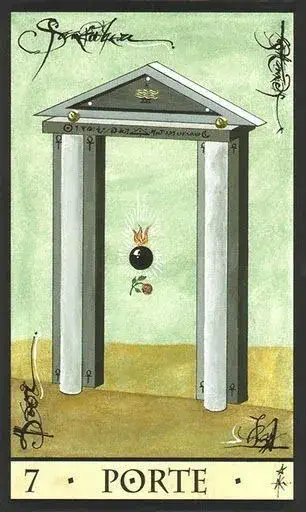
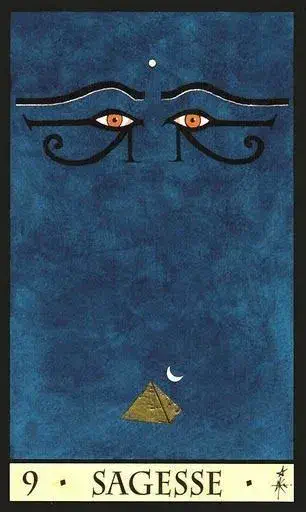
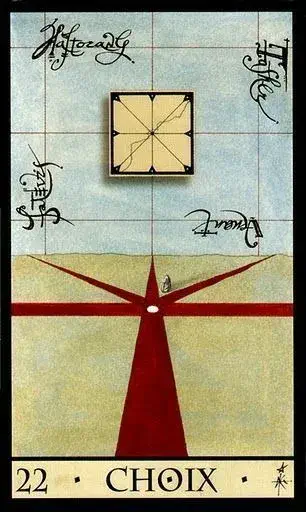
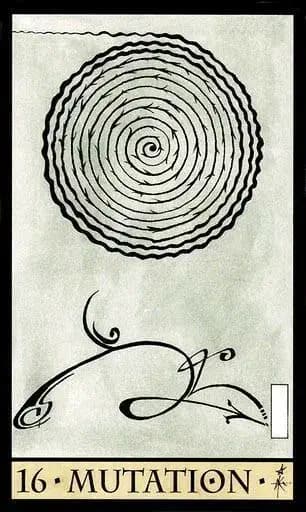
The Door · Wisdom · Choice · Mutation
You're hesitating between starting with the Oracle of the Triade or the Marseille Tarot. Two tools, two philosophies, six centuries apart. This guide compares both decks honestly — origins, structure, symbolism, user profile — to help you choose the one that fits your temperament and your questions. By the end, you'll know which way to lean (or whether to own both).
Why compare Triade and Marseille Tarot
Both tools serve the same purpose — to illuminate a question, accompany a decision, structure inner reflection — but with very different sensibilities. The Marseille Tarot draws its strength from historical depth and the richness of its archetypal symbols. The Oracle of the Triade draws its strength from accessible simplicity and contemporary relevance. Choosing between them is choosing a relationship to the symbolic.
The classic beginner's mistake: thinking that "you have to start with the Tarot because it's more serious." The truth is more nuanced — each has its strengths, and the right tool depends on your temperament, the time you want to invest, and the type of questions you ask. To explore the Triade first, see the Triade hub.
Origins: six centuries apart
The Marseille Tarot has its roots in 15th-century Northern Italy. The first identifiable cards appear in noble decks around 1440, like the Visconti-Sforza Tarot. In the 17th century, production shifted to Marseille and Lyon — hence the name — and the iconography stabilized around the engravings of Jean Noblet (1650) and then Nicolas Conver (1760), today considered references. It's an inherited tool, reworked by every generation for over five hundred years.
The Oracle of the Triade was created in 2002 by the French writer and cartomancer Didier Doncieux, illustrated by Daniel Coudoux. It's a contemporary tool, designed as a single piece with strong internal coherence: each card finds its echo or its opposite in another card of the deck (alpha/omega, water/fire, day/night, wisdom/illusion). This conceptual unity is rare among modern oracles, where cards often accumulate without an overall logic.
The contrast matters for what follows: the Tarot carries the voice of a collective tradition; the Triade carries the voice of a single author with a clear project.
Deck structure: 78 vs 57 cards
The Marseille Tarot comprises 78 cards split into two groups:
- 22 Major Arcana (from The Fool to XXI The World), carriers of the great universal archetypes.
- 56 Minor Arcana, organized in four suits (Wands, Cups, Swords, Coins), each composed of 14 cards: Ace, 2–10, and four court cards (Page, Knight, Queen, King).
This pyramidal structure is powerful: the Majors set the spiritual tone of a reading, the Minors clarify the concrete circumstances (relational, material, intellectual, emotional). But it also takes time to integrate.
The Oracle of the Triade comprises 57 cards, with no Major/Minor split, no court cards. Each card carries a name (Alpha, Water, Door, Justice, Light, Omega…) and a self-contained meaning. Reading is done by triads — hence the name — meaning you draw three cards that converse with each other to form a global message.
The Triade format is more immediate. No hierarchy to learn, no four suits to memorize, no court cards to integrate. For more on the structure, see the complete Triade guide.
Symbolism: universal archetypes vs contemporary resonance
The Marseille Tarot unfolds a dense symbolism, accumulated in strata over five centuries. A single card can be read through several lenses:
- Numerological: the Roman numeral value (XV of The Devil, XVII of The Star) carries its own meaning.
- Chromatic: each color (red passion, blue spirituality, yellow thought, white purity, green life) adds a layer.
- Iconographic: each object, each gesture, each animal has its resonance.
- Cosmological: correspondences with planets, elements, the sephirot of Kabbalah.
This richness makes the Tarot an almost inexhaustible tool. It's also what discourages many beginners — there's always more to learn.
The Oracle of the Triade bets on restraint. The illustrations are contemporary, readable, free of symbolic overload. Each card plays on a few clear resonances rather than an accumulation of signs. Meaning emerges more from immediate intuition than from scholarly analysis. It's a strength for those seeking a quick answer; a limit for those seeking exegetical depth.
Divinatory approach: tradition vs introspection
This is the most structuring difference.
The Marseille Tarot belongs to an ancient divinatory tradition. For centuries it was used for "predictive" readings — announcing an event, a marriage, a journey, a meeting. This dimension persists, though the modern reading (since Jodorowsky, Camoin, Marteau, and others) has refocused the Tarot on a function of psychological mirror and spiritual map.
The Oracle of the Triade is from the outset an introspective tool. Doncieux didn't design it to predict, but to help understand a situation, shift a viewpoint, illuminate an inner dilemma. The cards don't say "what will happen" but "what's at stake," "what calls for attention," "what may open."
Practically, that means:
- If you're looking for a yes or a no, the Tarot lends itself more naturally (though it often refuses the binary).
- If you're looking to understand what's happening inside you, the Triade goes straight to the point without symbolic detour.
Learning difficulty
| Criterion | Marseille Tarot | Oracle of the Triade |
|---|---|---|
| Number of cards | 78 | 57 |
| Structure to learn | Majors/Minors/Court | None |
| Numerology to master | Yes (key to meaning) | No |
| Color symbolism | Yes | Marginal |
| Historical tradition to digest | Five centuries | None |
| Time to basic comfort | 6–12 months | 2–3 months |
| Depth of learning | Bottomless | High but bounded |
The Triade yields usable results very quickly. The Tarot demands patience, but the investment is rewarded with a depth few tools match.
For which profile?
Choose the Triade if you:
- are starting out in cartomancy and want fast results
- prefer intuition over erudition
- want a daily personal-coaching tool
- feel uneasy with old imagery (royal courts, medieval allegories)
- want a contemporary tool that "speaks your language"
- mostly draw for yourself, journal-style
Choose the Marseille Tarot if you:
- are drawn to esoteric traditions and the history of symbol
- want a tool whose exploration will last a lifetime
- pay attention to iconographic detail (gesture, gaze, color)
- practice or want to practice reading for others
- want to articulate psychology, spirituality, and archetypes
- have the time and taste for long study
Choose both if you:
- draw regularly and want to vary angles
- have the budget for both decks and room to store them
- are curious by nature
Can they be combined?
Technically yes, but it's not advised. The iconographies are so different that mixing them in the same spread produces symbolic noise more than a clarified signal. The brain no longer knows which register to prioritize: the Tarot's gnostic archetype or the Triade's contemporary resonance?
Better: own both and choose by question.
- Life-orientation question, heavy decision, multi-phase situation → Tarot.
- Immediate emotion, block to understand, daily mood check → Triade.
Many seasoned practitioners end up alternating by mood and question type. The two tools don't compete; they cover complementary territory.
In short
The Marseille Tarot is a bottomless symbolic ocean, heir to a centuries-old tradition, demanding and infinitely rich. The Oracle of the Triade is a clear lake, immediately accessible, deep in its own way, cut for contemporary inquiry. The right choice depends less on the "value" of each tool than on your temperament and your questions.
To get started with the Triade, explore the 57 cards of the deck or discover the triangle spread method. For the Marseille Tarot, OracleNova doesn't currently include this deck — look to references like Alejandro Jodorowsky (The Way of Tarot, 2004) or Philippe Camoin for a rigorous introduction.
Going further
If this guide helped, you'll likely enjoy our related deep-dive: The Oracle of the Triade: Everything You Need to Know in 5 Minutes — a companion piece that picks up where this one ends.
Browse every essay in the Articles & Guides hub to keep going.
Frequently Asked Questions
→Which deck is best for a complete beginner?
The Triade. With no court cards (King, Queen, Knight, Page) and no thousand-year tradition to digest, it's immediately accessible. The Marseille Tarot requires a minimum of training: numerology, theory of elements, reading of symbolic colors. Many apprentice tarot readers start with the Triade to develop their intuition, then move to the Tarot when they want a more structured reading.
→Can the Marseille Tarot be read introspectively like the Triade?
Yes — and that's the dominant modern reading since Alejandro Jodorowsky. The Marseille Tarot isn't intrinsically predictive; it's a symbolic toolbox. The difference with the Triade comes mainly from symbolic density: the Tarot offers more layers (gnostic, alchemical, kabbalistic) but also demands more time to explore them.
→How long does it take to master each one?
Triade: 2–3 months of regular practice to feel comfortable with the 57 cards and their interactions. Marseille Tarot: 6 months to 1 year to integrate the 78 cards, their combinations, the grand tableau reading, and to acquire interpretive fluency. No one ever fully 'masters' the Tarot — the depth remains bottomless.
→Is the Triade less 'serious' than the Tarot?
No — that's a common prejudice from traditionalist tarot readers. The Triade is a contemporary tool, created in the 2000s by Didier Doncieux with real symbolic coherence (alpha/omega, water/fire, day/night). It doesn't carry the Tarot's historical weight, but it owns its modernity — that's its strength, not its weakness. A tool doesn't need to be ancient to be accurate.
→Can they be combined in a single spread?
Possible but not recommended. Mixing iconographies blurs symbolic signals and tires the reader. It's more effective to choose the right tool for the question — Triade for personal-growth questions and life decisions, Tarot for situations with multiple dimensions (complex relationships, phase transitions, existential choices). You can own both and alternate.