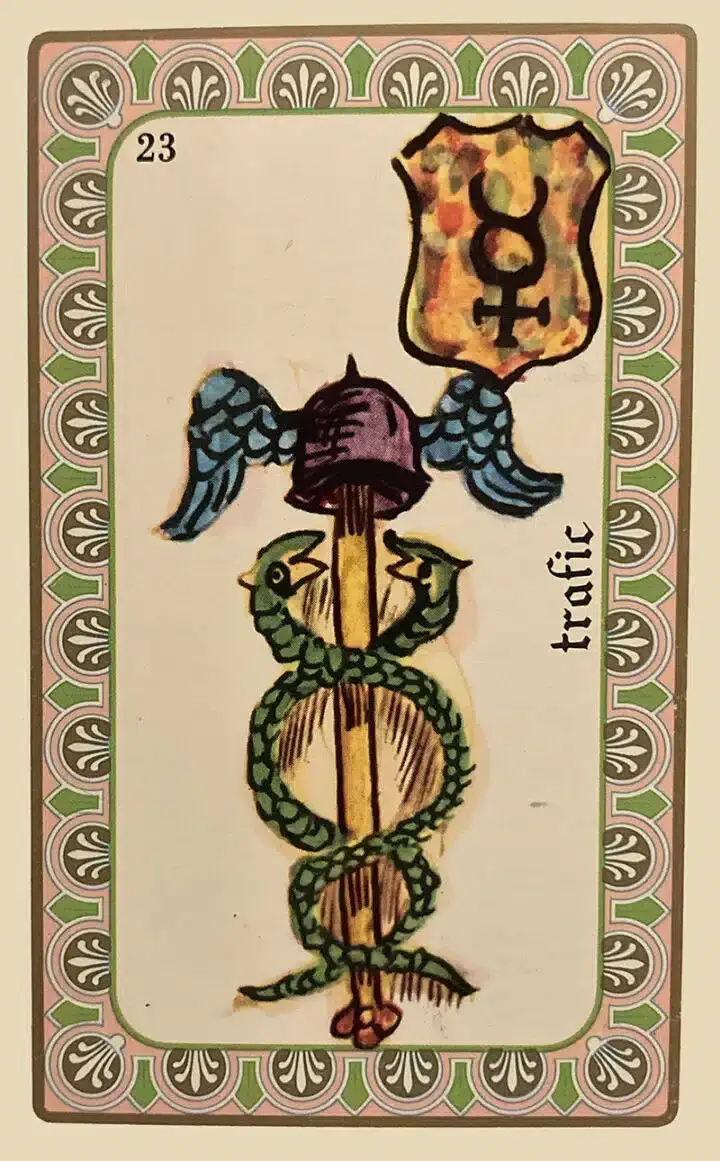
Belline · Card #23 · ☿ Mercury
Trade — Belline
“Exchange made profitable, commerce in motion, Mercury's gift for mutual benefit”
Trade belongs to Mercury (☿) — and the connection is ancient. In classical mythology and astrology, Mercury was the patron of merchants, travellers, and all those who moved goods, money, and information between parties. He governed the crossroads — the literal marketplace — where different communities, goods, and ideas met and were exchanged. Trade in the Belline system therefore represents the full Mercurian economy of exchange: not just commerce but any mutually beneficial transaction, including the exchange of ideas, skills, and goodwill. Mercury's intelligence applied to commerce is specifically the intelligence of negotiation: understanding what each party needs, finding the terms where both can say yes, communicating persuasively, and moving quickly to close before conditions change. This is the craft of the merchant and the diplomat alike, and the Trade card honours it as a genuine intellectual and social skill. In the esoteric tradition, Mercury's commercial function was always paired with his function as communicator and psychopomp. The best trade — in the tradition's view — is not extraction but genuine exchange: both parties give something real and receive something real, and the interaction leaves both better than before. This reciprocal enrichment is the ideal the card invokes.
General Meaning
Trade in a reading signals that commercial activity, negotiation, or exchange is central to the querent's current situation. A business transaction is in process or should be initiated. A negotiation is at a critical stage. An exchange — of goods, services, information, or goodwill — is about to take place, and how it is handled will have significant consequences. The card covers a wide range of commercial activity: a sale, a purchase, a business partnership, a professional contract, a negotiated settlement, a barter arrangement, or the exchange of skills and services without money changing hands. What all these share is the Mercurian quality: they require clear communication, mutual understanding, and the agility to find terms that work for both parties. Beyond commerce specifically, the card can indicate any situation involving the principle of fair exchange: receiving what you have given, giving what you have promised, and ensuring that the transaction is genuinely equitable rather than exploitative.
Positive aspects
In a positive position, Trade promises successful commercial activity — a deal that closes well, a transaction that benefits both parties, a business venture that proves profitable, or a negotiation that reaches a satisfactory resolution for all concerned. Mercury's swift and agile energy is available: terms will be found, communication will be effective, and the exchange will proceed smoothly. For those in commercial, legal, or advisory professions, the card is a direct endorsement of the current approach: the strategy is sound, the communication is effective, and the deals being pursued are worth pursuing. Excellent timing for contract signings, business launches, and important negotiations.
Challenging aspects
When surrounded by difficult cards, Trade can indicate commercial difficulty: negotiations that stall, deals that fall through, transactions that prove less profitable than expected, or business relationships that sour. Betrayal (12) beside Trade is a particularly significant combination: a commercial partner is not dealing in good faith. The card can also warn of a transaction that appears fair but contains hidden costs or conditions — the Mercury who deceives as well as the Mercury who facilitates. Read the small print; verify what has been promised; do not assume that goodwill is present just because communication has been smooth.
Meaning by Domain
Love
The exchange of affection, care, and commitment in relationships — the relational economy of give and take. Can indicate a relationship that operates transactionally (which may or may not be a problem, depending on whether the exchange is genuinely fair). For singles, a connection made through commercial or professional contact.
Career
Commerce, sales, negotiation, deal-making, business development, trade (in all its senses). The card is most at home in readings about business activity. Contract negotiations, client acquisition, business partnerships, and market transactions are all highlighted.
Health
The exchange of health information between patient and practitioner — getting the full picture, communicating symptoms accurately, negotiating treatment options. Can also indicate that the body's own internal exchange systems (metabolism, circulation, endocrine signalling) are functioning well.
Spirituality
The spiritual economy: what we give to our practice and what we receive from it. The relationship between teacher and student as mutual exchange. The principle that genuine spiritual transmission is not extraction but reciprocal enrichment.
Finances
Commercial transactions in all their forms. The card is positive for business finances — active commerce, profitable exchanges, and the financial rewards of good negotiation. A specific deal that is worth pursuing.
Trade in Combinations
Trade is activated and specified by what accompanies it. With Money (20), the commercial activity is financially rewarding — the deal is worth making. With Intelligence (21), the negotiation is skilfully conducted — the querent has the strategic acuity to find the best terms. With Enterprises (23), a new business is being launched and its commercial prospects are good. With Betrayal (12), the most significant warning: a commercial partner is not dealing honestly. Due diligence is non-negotiable. With Theft-Loss (22), assets or intellectual property in the transaction are at risk. With Departure (13), the trade relationship or commercial partnership is ending — someone is leaving the arrangement.
Key combinations
Historical Note
Mercury as the patron of commerce is one of the oldest and most consistent assignments in classical mythology — his Roman name itself is linked to merx (goods, merchandise). In 19th-century France, the growth of capitalism, the rise of the bourgeoisie, and the development of stock markets and commercial banks gave Mercury's Belline card an increasingly urgent contemporary relevance. The oracle's emphasis on Mercury-as-trader connects to the broader 19th-century confidence in commerce as a civilising force — the Saint-Simonian doctrine, influential in the circles where esoteric thought flourished, held that the free exchange of goods and ideas was the engine of human progress. The Belline Trade card reflects this cultural confidence even as it retains the ancient caution: not all merchants are honest, and Mercury is also the patron of thieves.
FAQ
Is Trade always about commercial business, or does it have broader meanings?
It has a wider application: any meaningful exchange — of services, favours, information, care — falls within this card's purview. What matters is the principle of reciprocal exchange and the Mercurial skill of finding terms that work for all parties.
What does Trade suggest about the timing of a commercial decision?
Mercury moves fast — his invitations are time-limited. The card suggests acting promptly on commercial opportunities: delays give competitors time to move and allow conditions to change. Strike while the terms are available.
How is Trade different from Enterprises (23) in career readings?
Enterprises is Mars's card of bold initiative and project launch. Trade is Mercury's card of ongoing commercial activity: selling, negotiating, exchanging. One launches; the other trades. A successful business needs both: the Martian courage to begin and the Mercurial agility to keep the commercial relationships running profitably.
Why is Mercury better suited to trade than Jupiter, who rules abundance?
Jupiter rules abundance as a state — the condition of having plenty. Mercury rules exchange as a process — the active transfer of value between parties. Trade is inherently dynamic, communicative, and relational; these are Mercury's domains. Jupiter's abundance may provide the goods that are traded, but Mercury conducts the transaction.
What should a reader do when Trade appears alongside very negative cards?
Be specific: which dimension of the commercial situation is problematic? Betrayal beside Trade = dishonest partner. Theft-Loss beside Trade = asset risk. Ruin beside Trade = the deal, if completed, will contribute to broader financial collapse. The negative cards specify the danger; Trade identifies the domain in which it operates. Address the specific risk rather than abandoning the entire commercial initiative.