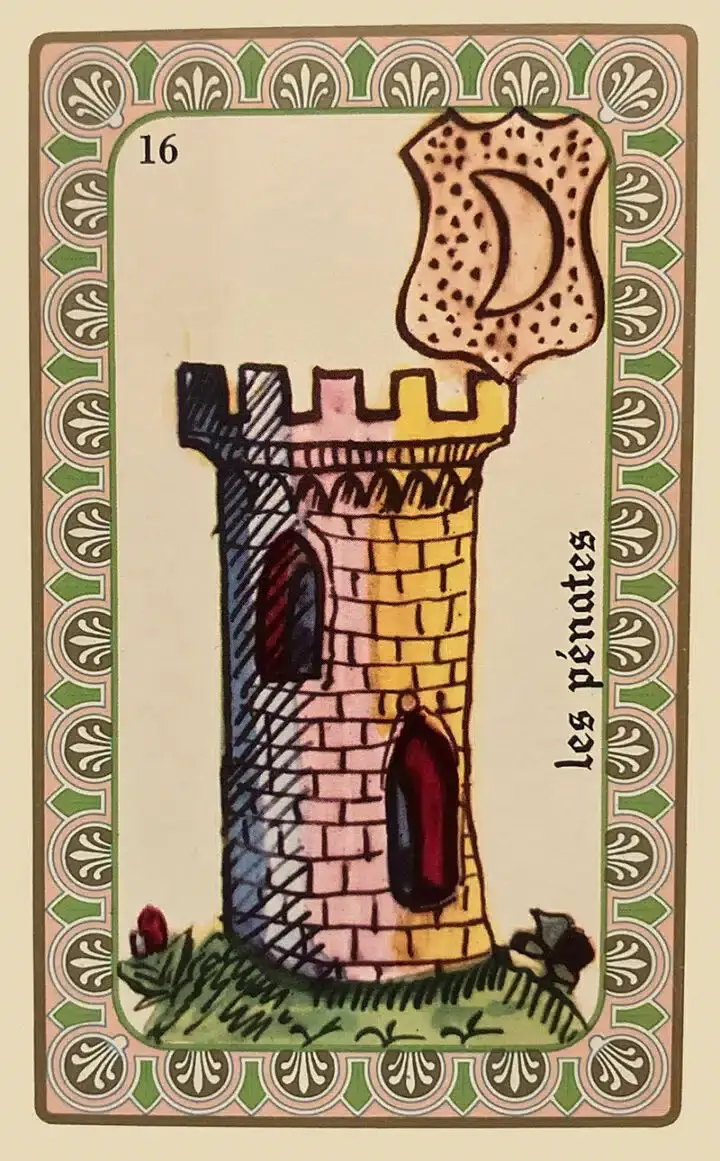
Belline · Card #16 · ♄ Saturn
Penates — Belline
“The hearth fires kept, ancestors honoured, the sacred centre of family life”
The Penates were the household gods of ancient Rome — the divine guardians of the family's larder and hearth, the invisible presences that kept the home safe, the storehouse full, and the family line continuing. Edmond de Grosmont's inclusion of this explicitly Roman religious concept in an 1845 French oracle reflects the 19th-century esoteric fascination with classical antiquity as a source of living spiritual truth, not merely archaeological interest. The card is governed by Saturn (♄) in his most constructive expression: not the heaviness of limitation and loss (which Saturn can also bring), but the solidity of enduring structures, the value of tradition, the weight of what has been accumulated and preserved across generations. The Penates represent everything that persists: the family home maintained across decades, the recipes passed down through grandmothers, the name carried forward, the stories told at the table. In the Belline system, home is never merely architecture. It is the psychic container of family identity — the space that holds the memories, the living relationship between the dead and the living within a lineage, the place where an individual is most themselves. The Penates card speaks to all of this: roots, belonging, ancestral protection, and the nourishing or challenging inheritance of family patterns.
General Meaning
Penates in a reading calls attention to home, family, domestic life, and the querent's relationship with their roots and lineage. At its most literal, the card can indicate matters concerning the family home: buying, selling, renovating, inheriting property; living arrangements; domestic life in all its textures. At a deeper level, Penates speaks to the querent's sense of internal belonging — the felt experience of having a home within themselves, connected to a lineage and a tradition that gives them a stable identity from which to engage with the world. When this internal home is secure, the querent can be genuinely generous with others, rooted enough to face significant external challenge without being destabilised. The card frequently appears in readings where family dynamics are central — not the immediate romantic partner (that is Love's territory) but the family of origin, the extended clan, the ancestral patterns that show up in the querent's adult behaviour. Questions about parents, siblings, grandparents, family inheritance (material and psychological), and family conflict are all within Penates' domain.
Positive aspects
In a positive position, Penates promises stability, domestic happiness, and the sustaining power of strong family roots. The home is or becomes a genuine refuge — a place of warmth, safety, and mutual support. Family relationships are deepened by honesty and care. Ancestors, understood metaphorically or literally, provide guidance and protection. The card is excellent for questions about property: buying or renovating a home, inheriting a family property, settling happily in a community. It also promises continuity — that something valuable built by previous generations will be preserved and enriched by the querent's generation. For those working on ancestral healing — the psychological and sometimes spiritual work of understanding and integrating family-of-origin wounds — Penates in a positive position signals that the work is bearing fruit: the patterns are becoming visible, the choices are becoming conscious, and the lineage is being transformed.
Challenging aspects
When surrounded by difficult cards, Penates draws attention to domestic dysfunction, family conflict, or a home environment that drains rather than nourishes. The ancestral inheritance may be a burden rather than a gift: toxic family patterns, financial entanglements, a family home associated with trauma rather than warmth. The card can also indicate that the querent is over-identified with family — defining themselves primarily through lineage, tradition, or parental expectations rather than through their own authentic values and choices. Saturn here becomes limitation rather than structure: the weight of family obligation prevents individual flourishing. In extreme readings (with very difficult surrounding cards), Penates can speak of family breakdown, the loss of a family home, or a lineage interrupted. The hearth fires that should be kept burning are going out.
Meaning by Domain
Love
The foundation of love: not passion (that belongs to Love and Passions) but the enduring domestic partnership — building a home together, creating a shared world, the quiet loyalty of years. This card is excellent for questions about marriage, cohabitation, and the long-term livability of a partnership.
Career
Family businesses, real estate, property management, architecture, interior design, culinary arts, preservation and heritage fields. Can also indicate working from home, or a career that is strongly shaped by family expectation or tradition.
Health
Health conditions with familial roots: genetic predispositions, inherited metabolic patterns, family beliefs about health and the body. The home environment's effect on health. Ancestral healing as a modality — clearing inherited trauma through therapeutic, ritual, or somatic work.
Spirituality
Ancestor veneration, family lineage as spiritual practice, the Roman Penates tradition itself. The idea that the dead continue to be interested in and capable of supporting the living. Dream contact with ancestors. The threshold of the home as sacred space.
Finances
Family finances: inheritance, family property, financial entanglements with relatives, the family business. The card often appears in readings about whether to accept or contest an inheritance, or about financial obligations to elderly parents or dependent relatives.
Penates in Combinations
Penates grounds and stabilises whatever it accompanies. With the Blue Card (1), it promises a home that is genuinely protected — an unusually fortunate domestic situation. With Gifts (11), it often indicates a family inheritance, particularly of property. With Betrayal (12) or Enemies (36), family betrayal or internal clan conflict is indicated — the most painful reading of this card, because it comes from within the protected space. Beside Departure (13), the combination describes leaving the family home — willingly or otherwise. With Ruin (52), it warns of loss of the family home or serious domestic financial crisis. With Destiny (2), the family home or family situation carries a fated quality — there are things about the lineage that the querent cannot choose, only navigate wisely.
Key combinations
Historical Note
The Penates were central to Roman domestic religion — every Roman home had a shrine (lararium) where the household gods were honoured daily with offerings of food, incense, and wine. When a family moved, they carried their Penates with them; to lose connection with one's Penates was understood as a spiritual catastrophe, a loss of the invisible protection that kept the family safe. Edmond de Grosmont's decision to include this explicitly Roman concept in the Belline oracle reflects the 19th-century educated Frenchman's immersion in classical culture (Latin and Greek were the foundation of the lycée curriculum), as well as the esoteric interest in reconstructing ancient spiritual practices understood to contain genuine wisdom. The Penates card is also continuous with the 19th century's intense interest in family: a period of demographic upheaval, urbanisation, and industrialisation that was eroding the extended family structures that had provided social stability for centuries.
FAQ
What exactly are the Penates, and why are they in a 19th-century French oracle?
The Penates were Roman household divinities who protected the family home, its stores of food, and its members. Grosmont included them because 19th-century esotericists understood classical religion not as historical curiosity but as living wisdom — the Romans' relationship with their household gods encoded genuine spiritual truths about how human beings flourish when their domestic life is consecrated and protected.
Does this card always concern the family of origin?
No — it can refer to the family the querent is creating (with a partner, children, chosen community) as well as the family they were born into. What matters is the quality of belonging: is there a home, in the deepest sense, that sustains and protects this person?
What does Penates say about ancestral trauma and healing?
It acknowledges that the family system carries both gifts and wounds across generations. In readings about personal psychology, Penates may indicate that current difficulties have their roots in patterns established generations before the querent was born. The good news: what was established can also be transformed. The card, ruled by Saturn, respects the reality of the past while not treating it as unchangeable.
How does Saturn's rulership shape the Penates card?
Saturn governs time, continuity, structure, and what endures. The Penates are quintessentially Saturnian: they are the accumulated, preserved, transmitted essence of a family across time. They represent what outlasts individual members — the house that stands after the people who built it are gone, the recipes still used three generations later, the stories that constitute family identity.
Can Penates appear when the querent has no family in the traditional sense?
Absolutely. Chosen family, the community of belonging created through friendship and shared values, the creative lineage of a tradition one has adopted — all of these can be the Penates' domain. The card asks: where do you belong? Who are your people? What hearth fires do you maintain? These questions have many possible answers.