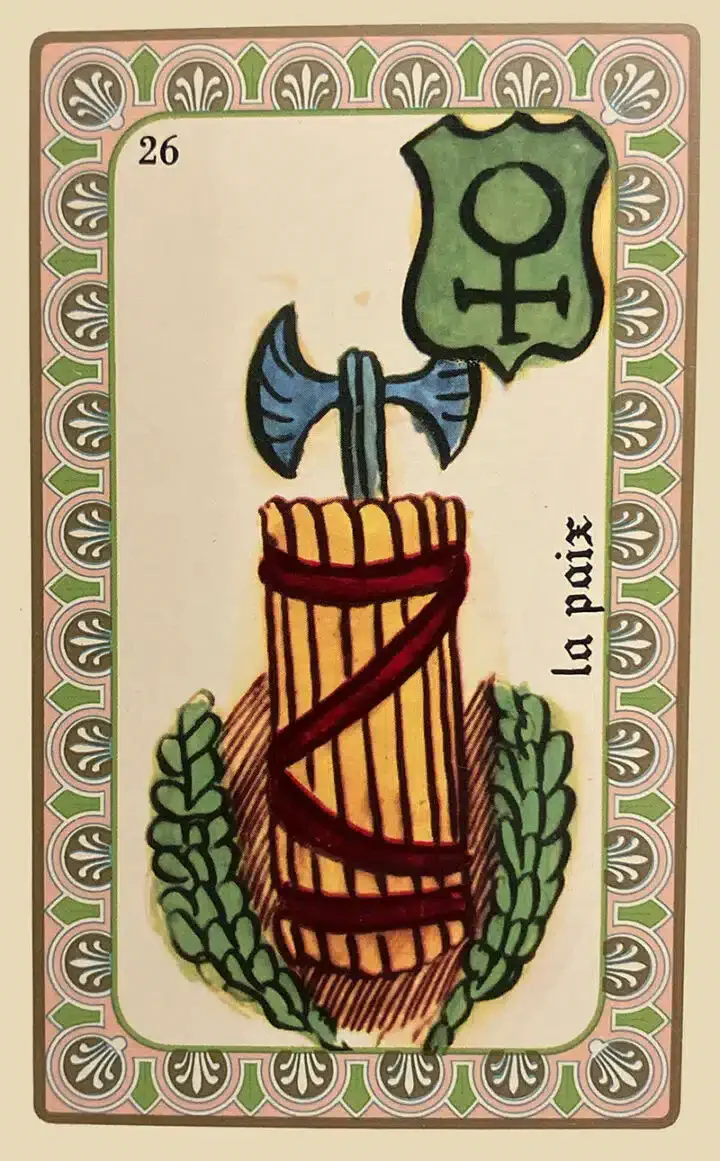
Belline · Card #26 · ♃ Jupiter
Peace — Belline
“Conflict resolved, harmony restored, the deep breath after the storm has passed”
Peace is governed by Jupiter (♃) in his harmonising, magnanimous dimension — the great benefic not as the giver of abundance but as the restorer of right relationship. Jupiter governs justice, diplomacy, and the broad-minded generosity that allows conflict to be resolved without either party being utterly defeated. Peace in the Belline tradition is not the absence of conflict — it is the restoration of genuine harmony after conflict has run its course. In the classical tradition, Jupiter ruled Sagittarius and Pisces: the first governed the philosopher and the explorer (broad perspective, the view from above conflict), the second governed the mystic and the peacemaker (dissolving of boundaries, compassion that transcends difference). Both contribute to this card: Peace requires the Sagittarian ability to see a situation from a sufficient altitude that particulars become less important than the whole, and the Piscean capacity to dissolve the ego attachments that keep conflict burning after it has served its purpose. The Belline Peace card is therefore a sophisticated spiritual achievement as well as a practical outcome. Real peace requires genuine change — in perspective, in posture, in what is held onto and what is released. It is not a treaty of exhaustion but a restoration of right relationship.
General Meaning
Peace in a reading signals that conflict, tension, or difficulty in the querent's situation is moving toward resolution. What has been at war — within a relationship, within a team, within the querent's own psyche — is finding its way toward harmony. The resolution may not be complete when the card appears, but its direction is clear: toward stillness, agreement, and the restoration of balance. In practical readings, the card can indicate: a negotiated settlement, a reconciliation between estranged parties, the resolution of a legal dispute, the end of a period of hostility, a truce that becomes a genuine peace, or a personal inner peace achieved after a period of struggle and self-examination. The Jupiterian quality of this peace is important: it is generous and open rather than guarded and provisional. Peace also appears when the querent needs to rest — to stop fighting, stop striving, stop resisting, and allow the natural equilibrium of a situation to reassert itself. Sometimes the most powerful action is the deliberate cessation of action.
Positive aspects
In a positive position, Peace is one of the most genuinely refreshing cards in the Belline deck. A difficult period is ending; the fighting is over; an agreement has been or is about to be reached. The querent can exhale. What was tense becomes relaxed; what was at odds becomes aligned; what was painful becomes the foundation of something stronger than what existed before the conflict began. Peace in a positive position is also personally transformative: the querent who has been at war with themselves — with their choices, their past, their nature — finds a period of inner reconciliation. They make peace with what has been, and in doing so, free enormous energy previously consumed by the internal conflict.
Challenging aspects
Peace in a difficult position can indicate a false peace — a surface calm that conceals unresolved tensions that will erupt again. The conflict has been suppressed rather than resolved; one or both parties has backed down from exhaustion or pragmatism rather than genuine reconciliation. This is the peace of the cold war, not the peace of genuine harmony. It can also suggest that the querent is avoiding necessary conflict in the name of peace — keeping the peace at too high a cost to their own integrity and needs. Not all conflict should be resolved through accommodation; some situations demand honest confrontation, and the Jupiterian peace that smooths everything over may be enabling something that needs to be changed.
Meaning by Domain
Love
Reconciliation after conflict, a restored romantic harmony, forgiveness genuinely offered and received. A relationship that has been through difficulty emerges stronger. Can also indicate a peaceful and calm relationship that is a refuge from the world — quiet, harmonious, deeply sustaining.
Career
The resolution of a professional conflict, a team that finds its working rhythm after a difficult period, a negotiated settlement in a workplace dispute, or the peaceful transition out of a difficult role. For those in peace-making professions (mediation, diplomacy, counselling), a period of particular effectiveness.
Health
The restoration of physiological equilibrium after a period of illness or stress. The nervous system settling; the inflammatory response resolving; the body finding its natural balance again. Peace in health readings is often the card of genuine recovery — not just symptom management but the restoration of underlying health.
Spirituality
Inner peace as a spiritual achievement — the fruit of genuine spiritual practice, not the avoidance of difficulty. The deep stillness described in contemplative traditions: the mind that rests in its own nature without the compulsive activity of ego-driven thought. Peace in spiritual readings can be one of the most significant cards a deeply-practicing querent encounters.
Finances
Financial settlement, the resolution of a dispute about money, a period of stability after financial turbulence. An agreement reached that satisfies all parties. The end of a period of financial anxiety.
Peace in Combinations
Peace brings resolution to whatever surrounds it. With Lawsuit (33), the legal dispute is settled — through mediation, agreement, or a favourable judgment. With Betrayal (12), the peace requires addressing the breach of trust directly — false harmony that skips this step will not hold. With Love (29), a romantic reconciliation or a period of exceptional harmony in a significant relationship. With Enemies (36), Peace specifically addresses the adversarial relationship — a truce has been or will be declared, though the reader must assess whether it is genuine. With Change (19), the peace is associated with a significant transition — harmony being restored at a new level, not a return to the old status quo. With Wisdom (44), the peace is the fruit of genuine understanding — both parties have grown, and the resolution is genuine.
Key combinations
Historical Note
Jupiter's role as the divine administrator of justice and social order in classical mythology made him the natural patron of peace in its political and social dimensions — the Pax Romana, the great peace that empire maintained at the point of a sword, was always understood as Jovian in character. But the Belline tradition, emerging from a more mystical and esoteric context, emphasises a different dimension: the peace of the soul, the inner harmony that Jupiter in his most benefic expression can bring. In 19th-century France — which had experienced the traumatic violence of revolution, counter-revolution, empire, and the revolutionary wars — peace was not an abstraction but an urgent social and personal need. Cartomancers regularly consulted about family conflicts, business disputes, and the lingering trauma of political violence. The Peace card carried enormous practical weight in this context, often consulted in the same session as Lawsuit, Enemies, and Betrayal.
FAQ
Does Peace always mean a conflict is ending?
Peace often marks the end of conflict, but it can also appear when the querent needs to cultivate peace where it is absent — as a prescription rather than a description. Or it may describe an existing situation of harmony that needs to be appreciated and protected.
Is Peace ever a negative card?
It can indicate false peace — the suppression of necessary conflict — which is ultimately more damaging than the honest confrontation it avoids. In a difficult reading, Peace may be the card showing that the status quo is maintained at too high a cost.
How is Peace different from Happiness (46) in the Belline deck?
Happiness is the experience of joy and flourishing — a positive emotional state. Peace is the restoration of harmony and balance — a relational and environmental state. One can be at peace without being particularly happy (after a difficult reconciliation, for example); one can be happy in a context that is not peaceful. The two often appear together, but they describe different qualities.
What does Peace suggest for a querent who is in active conflict with someone?
That the conflict has a resolution available — probably sooner than it feels. Jupiter's energy suggests that the broad view, the generous posture, and the willingness to find terms that both parties can live with will bring the conflict to a satisfactory conclusion. The card is encouragement to pursue resolution rather than escalation.
For advanced readers: what is the significance of Jupiter's governance of Peace in terms of traditional astrological sect?
Jupiter is a Diurnal planet — he operates best in daylight, public, conscious contexts. This tells us that Jovian peace is achieved through open, transparent, formally acknowledged resolution — through visible gestures of reconciliation, public agreements, formal settlements. Hidden peacemaking, secret deals made under the table, or unilateral decisions to 'let it go' without communication are not the Jupiterian way and are unlikely to hold. True peace, in this framework, must be expressed and acknowledged to be real.