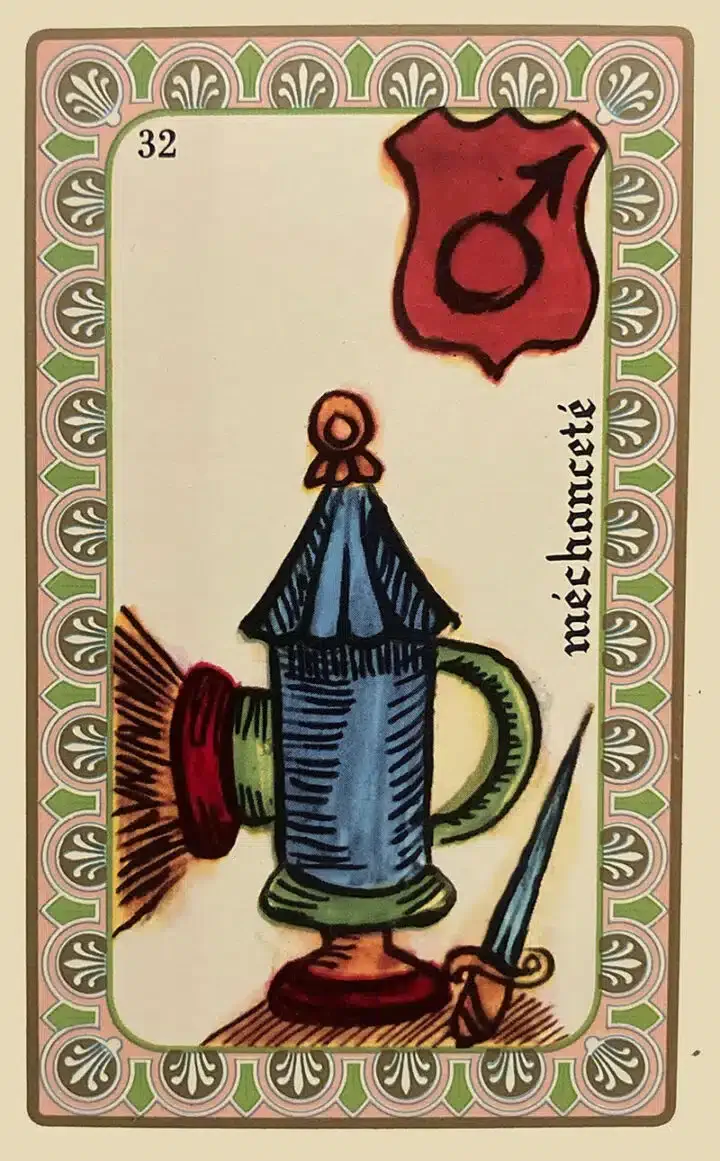
Belline · Card #32 · ♄ Saturn
Malice — Belline
“Ill will hidden beneath civility, spite in action, the shadow of human nature at its pettiest”
Malice sits in the Saturnian family — and this attribution captures something subtle and important. Saturn governs contraction, scarcity, and the hardening that occurs when abundance is withheld. Malice is what happens when the contracted, fearful, scarce-feeling dimension of the human psyche turns outward in ill will: the desire to harm, diminish, undermine, or poison what someone else has, not because it helps the malicious person but simply because they cannot bear that another should have it. In the Belline tradition, malice is distinguished from open enmity (which belongs to Enemies, card 36) and from betrayal (which belongs to Betrayal, card 12) by its quality: it is petty where Enemies is grand, covert where Betrayal is close, and motivated by spite or envy rather than strategic interest. The malicious person is not an adversary with a reason; they are someone whose diminished inner life expresses itself through the desire to see others fail. Saturn's attribution also gives Malice its particular flavour of cold calculation: unlike the hot anger of Mars, Saturnian ill will is patient, chilling, and persistent. It works slowly, steadily, and without the drama of open conflict — the cutting remark, the withheld information, the reputation quietly poisoned in conversations the target never knows took place.
General Meaning
Malice in a reading signals that ill will is present or active in the querent's environment — someone whose intentions toward the querent are not neutral but genuinely harmful, motivated by envy, spite, or a desire to see the querent diminished. This is not the honest enemy who opposes the querent openly; it is the person who smiles while working against them. The card invites the querent to examine their social environment with clear eyes. Who seems supportive but leaves the querent feeling subtly diminished? Who congratulates but seems to take pleasure in difficulties? Who is positioned to have access to the querent's vulnerabilities and might be using that access in harmful ways? Malice does not always indicate a specific individual — it can describe a cultural or organisational climate of envy and petty power-play, an environment in which the norm is to undermine rather than support. In such environments, the querent needs to be aware of the dynamic without becoming paranoid — the goal is protective clarity, not generalised suspicion.
Positive aspects
Malice rarely has a conventional positive reading — it is one of the more challenging cards in the deck. However, in some positions it can indicate that the querent is becoming aware of ill will that was previously hidden: the malice is being seen clearly for the first time, which is the necessary precondition for protection. The card may also appear when the malice has already been overcome — when it tried and failed to harm the querent, and what remains is the clear understanding of what was attempted.
Challenging aspects
In difficult positions, Malice indicates active harm being done through covert ill will: reputation attacks, gossip designed to damage, deliberate undermining of the querent's work or relationships, envy expressed through subtle sabotage. The damage may already be underway; the querent may be experiencing its effects without yet understanding the source. The card asks the querent to take protective measures: document their work, be careful about what they share and with whom, seek trusted advisers outside the potentially poisoned environment, and trust their instincts about who is safe.
Meaning by Domain
Love
A third party working against the romantic relationship through malicious gossip or deliberate interference. Envy of the couple's happiness. Can also indicate that one partner's ill will is being expressed through covert cruelty — the relationship that poisons through a thousand small cuts.
Career
Workplace malice: the colleague who poisons the querent's reputation with management, the competitor who undermines their work, the organisation's culture of punitive pettiness. The malicious co-worker is often the most draining challenge in professional life because the ill will is difficult to prove and exhausting to navigate.
Health
The health consequences of sustained exposure to malicious environments: the toll of workplace toxicity, relational cruelty, or the constant low-level stress of knowing that someone wishes you harm.
Spirituality
The encounter with genuine evil in the psychological and spiritual sense — not supernatural but very real: the capacity of the human shadow, unexamined and unintegrated, to express itself through deliberate harm to others. The card calls the querent to examine their own shadow as well as protect themselves from others'.
Finances
Financial malice: deliberate financial sabotage, bad advice given with harmful intent, the withholding of information that would benefit the querent. Review all financial advice received recently.
Malice in Combinations
Malice is one of the cards that demands the most careful reading of its companions, since it modifies everything it touches with the quality of covert ill will. With Betrayal (12), the malice is close and personal — someone trusted is acting from spite. With Enemies (36), the malice is part of a broader adversarial situation — active, organised opposition that includes an element of genuine wickedness. With Lawsuit (34), the legal action has a malicious rather than just adversarial dimension. With the Blue Card (1), even in this difficult situation, protection is present — the malice will not ultimately succeed. With Wisdom (44), the querent will navigate the malicious environment with sufficient intelligence and care to protect themselves. With Discovery (15), the ill will is on the verge of being uncovered — the malicious person's mask is about to slip.
Key combinations
Historical Note
Saturn's attribution to Malice reflects the planet's ancient association with cold, contraction, and the qualities that arise when the Jovian principle of generosity is absent. In classical and medieval astrological medicine, Saturnine individuals were prone to melancholy, envy, and a cold calculation that could tip into cruelty. The Belline tradition inherits this characterisation while grounding it in the social reality of human communities where petty spite is a constant and demoralising presence. 19th-century readers would have identified Malice readily with the social dynamics of the hierarchical French societies they inhabited — a world in which one's advancement depended heavily on one's reputation, and where the malice of a superior or a rival could destroy years of careful work. The card was consulted regularly in questions about workplace and social dynamics.
FAQ
How is Malice different from Enemies (36) and Betrayal (12)?
Betrayal is intimate — it comes from someone trusted. Enemies is open — the adversary is known and the conflict is direct. Malice is petty and covert — it comes from someone who may not even be significant in the querent's life but whose spite and envy motivate them to cause harm through indirect, deniable means.
Does Malice ever refer to the querent's own ill will?
Occasionally — particularly when the card appears in positions representing the querent's own inner state. It may be a mirror: are you allowing envy or spite to motivate actions that harm others? The card is asking for honest self-examination as well as protective awareness.
What practical steps can protect someone from malice indicated by this card?
Document your work and achievements. Be selective about what you share and with whom. Build relationships with people outside the immediately suspected environment. Trust your instincts about who makes you feel worse after every interaction. If the malice is workplace-based, maintain a professional record that can speak for itself.
Is malice always conscious and deliberate?
Not always — some people are destructive through unconscious envy and shadow expression rather than deliberate plotting. The effect on the querent is similar regardless of the malicious person's level of awareness. The Belline tradition does not require us to determine motive before protecting ourselves from harm.
What does Saturn's rulership of Malice tell us about how it operates?
Saturn's energy is cold, patient, and systematic. Saturnian malice therefore operates through slow accumulation rather than dramatic attack: the reputation poisoned drop by drop over months, the relationship subtly undermined through a succession of barely-perceptible interventions. This is why it is so difficult to recognise until the damage is already significant — and why the card's appearance in a reading is so valuable as early warning.