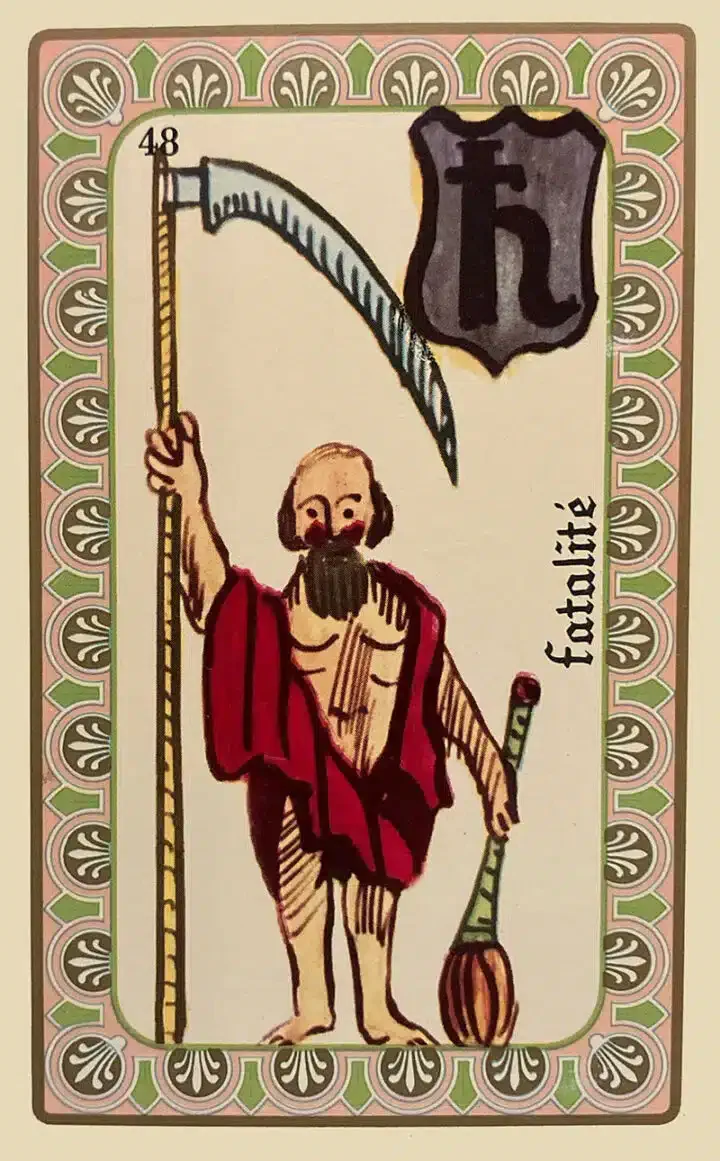
Belline · Card #48 · ♄ Saturn
Fatality — Belline
“What was always going to happen, the irreversible arrived, the moment beyond which nothing is the same”
Fatality is Saturn (♄) at his most absolute — not the testing of Misfortune (which can be navigated, endured, and grown through) but the irreversible arrival of what could not have been otherwise. In the classical esoteric tradition, Fatality describes the moments when human freedom meets the boundary of what has been determined: the death that could not have been prevented, the accident whose conditions were set in motion too long ago to alter, the collapse of a structure that had been undermined for years before it fell. The distinction between Destiny (2) and Fatality (49) is significant and carefully maintained in the Belline tradition. Destiny is Saturn as the long arc of purposeful shaping — the thread of a life running toward its genuine telos, offering choice at every turning point even while pointing a general direction. Fatality is Saturn as pure limit — the moment when the arc reaches its fixed point and what has been set in motion arrives at its conclusion, whether the human participants are ready or not. In the 19th-century Belline tradition, Fatality was most directly associated with death — particularly sudden, unexpected, or violent death. Modern readers approach this dimension with great care: the card rarely, if ever, warrants an explicit prediction of death in a reading, and experienced Belline practitioners are trained to read its most profound dimension as the death of a situation, relationship, or phase rather than of a person.
General Meaning
Fatality in a reading signals that something irreversible is present or arriving — an event or outcome that has moved beyond the domain of choice and entered the domain of what must be accepted. This may be a death (of any kind — physical, relational, professional, or in terms of a phase of life), a conclusion that cannot be undone, or the arrival of consequences from causes set in motion too long ago to now address. At its most fundamental, the card raises the question of acceptance: how does the querent relate to what cannot be changed? The Stoic and Buddhist traditions — both of which influenced the 19th-century esoteric milieu in which Belline developed — understood acceptance of the unalterable as a genuine spiritual capacity, the development of which is one of life's most important achievements. Fatality, in this reading, is the teacher of radical acceptance. In more practical readings, the card indicates: a situation that has moved past the point where intervention is effective, a relationship or project that has reached its natural end, an outcome that is now fixed regardless of what is done next. The wisdom the card offers is not about changing what cannot be changed but about how to face what is coming or has arrived with dignity, truth, and the deepest resources of the human spirit.
Positive aspects
It may seem paradoxical, but Fatality can carry a form of relief when it appears in a reading. The uncertainty is over — what has been feared, what has been suspended, what has been held in terrible ambiguity has now resolved into a definite reality that, however painful, can at least be faced and worked with. The end of waiting, even when what has ended is good, carries a particular form of grace: at last, one knows where one stands. For those who have been prolonging situations that needed to end — relationships that were not genuinely alive, projects that had no real future, identities that had been outgrown — Fatality's arrival can clear the ground for the genuine renewal that can only begin when the old has truly ended.
Challenging aspects
In its most difficult reading, Fatality confronts the querent with what they most feared or with what most urgently needed to be avoided. The loss is real; the ending is final; the road not taken cannot now be taken. Grief is the appropriate response to genuine loss, and this card honours the reality of that grief rather than rushing past it. The practical wisdom the card offers is always the same: face it, feel it, find the support to bear it, and — in Saturn's patient time — allow the new that can only grow from genuine endings to emerge from the ground of what has been.
Meaning by Domain
Love
The irrevocable ending of a relationship — not the temporary separation of Departure but the final, definitive conclusion. A love that has reached the end of its natural life. Grief for what has been genuinely lost. The death of a partnership.
Career
The definitive conclusion of a professional chapter — a closure that cannot be reversed. The career that is truly over, the business that cannot be revived, the professional identity that must be relinquished. The ending that is also the condition for a new beginning.
Health
The card's most serious health reading — when combined with Illness and Misfortune, it can indicate a very serious health situation with potentially fatal dimensions. Approached with great care and sensitivity, always in context. More commonly: the irrevocable diagnosis that changes everything, the health reality that must be accepted and lived with.
Spirituality
The encounter with mortality as spiritual teacher. The ego death that genuine initiation requires. The surrender of the individual will to the larger will of the cosmos — the Fiat voluntas tua of all mystical traditions. Acceptance of what cannot be changed as the deepest spiritual practice.
Finances
The financial situation that has moved beyond recovery — a bankruptcy, a debt that cannot be paid, a loss that cannot be recovered. More commonly: a financial conclusion (a contract ended, an investment concluded) that is definitive and must be accepted as the new reality.
Fatality in Combinations
Fatality is the most weighty card in combination readings. Its significance is always modified but rarely fully overridden by its neighbours. With the Blue Card (1), even the most difficult Fatality carries a form of divine protection — something, at least, endures and is preserved through the irreversible event. With Wisdom (44), the encounter with what cannot be changed is met with extraordinary maturity and grace. With Illness (18) and Misfortune (47) together, this is the deck's most serious health combination — approached with the greatest care. With Change (19), the irreversible event triggers the transformation that was always necessary. With Happiness (46), a remarkable combination: what ends was holding the querent back from genuine flourishing — the fatality is, in retrospect, a gift.
Key combinations
Historical Note
The concept of Fatality in 19th-century French esoteric thought drew on multiple traditions: the classical Greek Moira (the inexorable fate), the Roman Fatum, and the emerging scientific determinism of the industrial age all contributed to a cultural conversation about what is determined and what is free. Cartomancers navigating this conversation used the Fatality card to acknowledge both: there are genuinely determined moments in human life (moments of irreversible consequence), and within those moments, there remains the freedom of how one faces what cannot be changed. Edmond de Grosmont's Saturn attribution for Fatality reflects the deepest classical doctrine: Saturn was the keeper of time, and time is precisely the dimension in which things become irreversible. What has happened cannot unhappen; Saturn is the god who ensures that the past remains the past.
FAQ
Does Fatality always mean someone will die?
No — and modern readers should approach this dimension with the greatest care. Fatality most commonly indicates the irreversible ending of a situation, relationship, or phase. Physical death is one possible reading in very specific combinations, but it should never be the first or default interpretation.
What is the difference between Fatality and Destiny in Belline?
Destiny (2) is Saturn as purposeful guidance — the long arc of a life running toward its genuine telos, offering choices at turning points. Fatality (49) is Saturn as pure limit — the moment of irreversible arrival, beyond which nothing is the same. Destiny shapes; Fatality arrives.
How should a reader respond when Fatality appears in a reading?
With honesty and compassion. Name what the card is indicating — an irreversible ending or arrival — without catastrophising or specifying physical death without very specific contextual warrant. Focus on how the querent can navigate what cannot be changed with dignity, support, and genuine resources. The card teaches acceptance; the reading should model it.
Can the effects of Fatality be prevented or mitigated?
Mitigation is occasionally possible through the surrounding cards — the Blue Card and Support can contain and soften even Fatality's arrival. Prevention is rarely available once this card appears in a strong position: it describes what has moved beyond the reach of ordinary intervention. The wisdom it offers is navigational, not preventive.
For advanced readers: what does the doctrine of the Lot of Fortune and the Lot of Spirit in traditional astrology contribute to understanding Fatality?
The Lot of Fortune (☽ + Ascendant − ☉) and Lot of Spirit (☉ + Ascendant − ☽) represent the two axes of fatedness in the natal chart: Fortune governs what happens to the individual (external fate); Spirit governs the individual's deliberate, conscious action (internal choice). Fatality in the Belline reading sits primarily in Fortune's domain: it describes what arrives from outside the individual's control, what happens to them rather than what they consciously choose. The reading therefore focuses on the quality of the response — which is Spirit's domain, and which always remains free — rather than on the event itself, which is Fated.