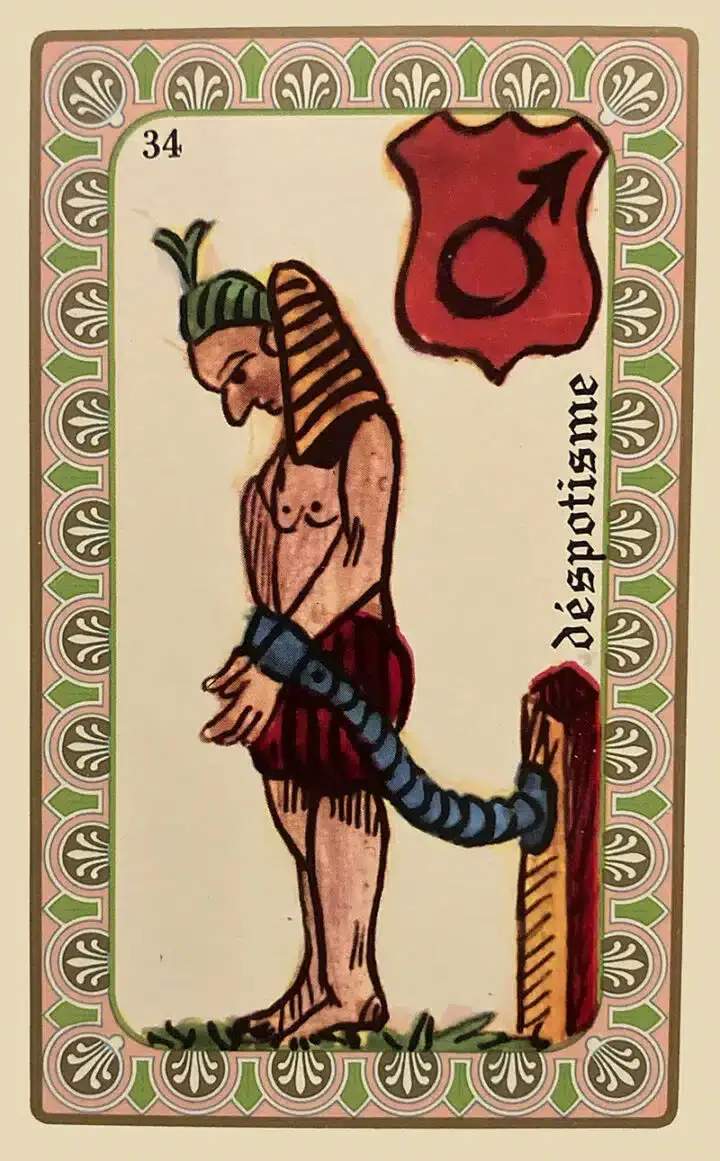
Belline · Card #34 · ♄ Saturn
Despotism — Belline
“Power turned tyrannical, authority without accountability, the crushing weight of unjust control”
Despotism is Saturn (♄) in his most distorted and destructive expression — not the legitimate authority and just structure that Saturn at his best provides, but the hardening of power into rigid, unaccountable control that serves only the powerful. In classical and modern history, the despot is the ruler who has forgotten that authority is a trust: who treats subjects as resources to be managed rather than people to be served, who mistakes force for legitimacy, and who fills the vacuum of genuine wisdom with the false substitute of domination. In the Belline tradition, Despotism describes any relationship or situation in which power is exercised without accountability, in which the weaker party is controlled, constrained, or coerced by the stronger party's will. This can be political (an authoritarian regime), institutional (a tyrannical employer or institution), interpersonal (a controlling partner, parent, or friend), or even internal (the inner critic that has become a tyrant, the inner voice of shame that controls behaviour through fear rather than wisdom). Saturn's attribution is significant: despotism is not chaos but a form of negative order — a rigid, fear-based structure that maintains its form through coercion rather than consent. Saturn governs all structures; despotism is what happens when those structures lose their orientation toward the good of all and become instruments of the few.
General Meaning
Despotism in a reading signals that an abusive or oppressive power dynamic is present in the querent's situation — someone (a person, an institution, an internal dynamic) is exercising control in ways that are harmful, unjust, and without appropriate accountability. The querent may be the person being controlled, or they may be in proximity to a situation of despotic control that is affecting them indirectly. In practical readings, the card covers: a controlling or abusive relationship (romantic, familial, professional), an authoritarian workplace or institution, a political situation of oppression, or the querent's own relationship with inner forces (perfectionism, shame, self-criticism) that have become tyrannical. The key quality in all these is the absence of genuine consent and the presence of coercion — not the healthy authority of the wise leader or the loving parent but the suffocating control of the despot. The card is also an invitation to examine where, if anywhere, the querent's own exercise of power has tipped from appropriate authority into control. Saturn's mirror works in both directions.
Positive aspects
Despotism rarely has a straightforwardly positive reading — it is one of the more challenging cards in the deck. However, in some positions it signals that the oppressive situation is being recognised clearly for the first time, or that the querent is finding the courage and resources to challenge or exit the tyrannical situation. The card in these contexts marks the beginning of liberation rather than the continuation of oppression.
Challenging aspects
In difficult positions, Despotism indicates that the control being exercised is severe, entrenched, and difficult to escape. An abusive relationship in which leaving appears impossible. A workplace so hierarchically controlled that individual agency is eliminated. A family system so enmeshed that individual boundaries are treated as betrayal. The oppressive structure has real power and will not yield easily or willingly.
Meaning by Domain
Love
A controlling or abusive romantic relationship — the partner who monitors, constrains, isolates, and coerces. This is one of the most serious readings the card can receive: when Despotism appears in a love reading, the safety of the querent must be the primary concern.
Career
The authoritarian employer, the micromanaging superior, the workplace culture of fear and surveillance. A situation where professional autonomy has been eliminated and performance is driven entirely by fear of punishment.
Health
The health consequences of sustained oppression: the chronic stress of controlled environments, the physical effects of fear and coercion on the nervous system and immune function. Can also indicate a medical situation where the patient's autonomy is not being respected.
Spirituality
The spiritual authority that has tipped into spiritual abuse: the guru who controls through fear, the religious institution that coerces compliance rather than inviting genuine devotion. The inner spiritual tyrant: perfectionist spiritual practice that has lost its compassion.
Finances
Financial control as a tool of oppression: a partner who controls all financial resources as a means of maintaining dominance. Institutional financial exploitation. An economic situation in which the querent has no agency.
Despotism in Combinations
Despotism is one of the most serious cards in terms of combination readings. With Betrayal (12), the oppressive figure is also deceptive — the combination of control and hidden betrayal is particularly harmful. With Enemies (36), the querent faces both open adversaries and tyrannical control — a very difficult situation requiring careful strategy. With Departure (13), liberation through leaving — the only exit from the despotic situation may be physical or relational departure. With the Blue Card (1), protection is present even in the oppressive situation — the despotism cannot reach the deepest level of the querent's self. With Wisdom (44) and Peace (27), there is a path through the oppressive situation that leads to genuine resolution. With Ruin (52), the despotic situation is contributing to serious collapse.
Key combinations
Historical Note
Saturn's attribution to Despotism reflects the planet's ancient dual role: at his best, Saturn is the just judge and the builder of enduring institutions; at his worst, he is Kronos devouring his own children — the tyrant who fears the future and controls through destruction. This mythological ambivalence is captured precisely in the Belline card: Saturn's authority without Saturn's wisdom produces not just order but oppression. 19th-century France had living memory of multiple forms of political despotism — the Terror, the Napoleonic empire, and the restored monarchies all offered versions of authority that crossed the line into tyranny. Cartomancers reading this card were speaking to clients who understood despotism not as a historical abstraction but as a lived political and personal reality.
FAQ
Does Despotism always refer to a political tyrant?
No — it is far more often interpersonal or institutional: a controlling partner, an authoritarian employer, a domineering parent, or an inner voice of shame and self-criticism that has taken on tyrannical qualities. Political despotism is one form; personal despotism is more common in readings.
What should a reader do if this card appears in a reading about a domestic relationship?
Take it seriously. Despotism in a love or family reading can indicate an abusive or controlling relationship that poses real risk. The reader's first concern is the querent's safety and access to support. The surrounding cards will provide context, but Despotism in domestic settings should never be minimised.
Can Despotism refer to my own controlling behaviour?
Yes — in positions representing the querent's own energy or actions, it may be asking them to examine where their own exercise of authority has become controlling or coercive. This is the card's most difficult but potentially most useful reading for someone in a position of power.
How does Saturn's oppressive dimension in Despotism relate to his constructive dimension in other cards?
Saturn's constructive energy (in Penates, Lawsuit, Change, and Illness) builds structure, maintains tradition, enforces justice, and creates the conditions for long-term flourishing. Despotism is these same capacities turned toward self-serving control rather than the good of all. The difference between authority and despotism is whether power is exercised for the benefit of those over whom it is held or for the benefit of those who hold it.
For advanced readers: what does the ancient doctrine of Saturn as the 'Greater Malefic' contribute to reading this card?
In classical astrology, Saturn was identified as the Greater Malefic — the most challenging planetary influence — because his extremes were the most severe: he built great civilisations and also destroyed them, he maintained justice and also became the cold tyrant. Despotism is Saturn at his worst: the maximum expression of the Greater Malefic's shadow. The reader who understands this will bring appropriate gravity to the card's appearance — not catastrophism, but honest acknowledgement that the challenge it describes is real, serious, and requires wisdom, courage, and often external support to navigate.