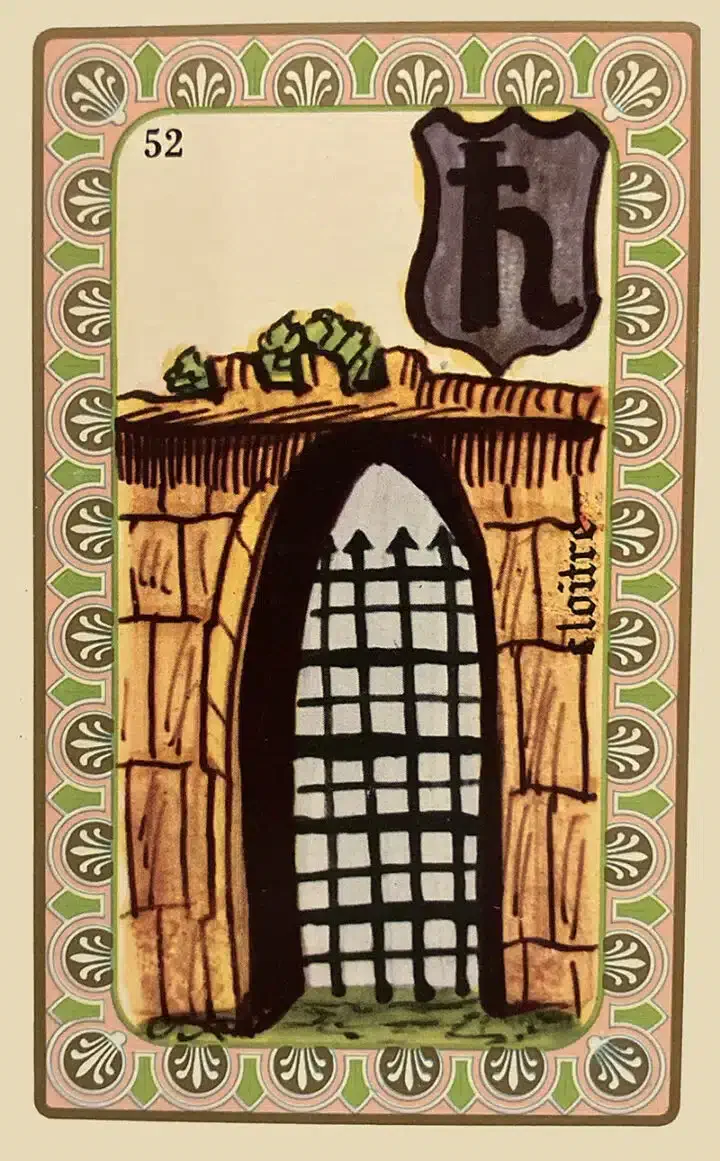
Belline · Card #52 · ♄ Saturn
Cloister — Belline
“The world stepped back from, the interior made sacred, Saturn's invitation to depth and solitude”
Cloister is the final card of the Belline deck — Saturn (♄) in his most contemplative, interiorised, and spiritually significant expression. The cloister — the enclosed garden of the monastery or convent, the protected interior space separated from the world by walls and intention — represents the sacred principle of withdrawal: the deliberate stepping back from the noise, demands, and distractions of ordinary life in order to attend to what is most essential and most interior. In the Western monastic tradition from which the card's imagery draws, the cloister was the heart of the religious life: the space where the community gathered in silence, where walking meditation was practised, where the relationship with the sacred could be cultivated without constant interruption. The cloister's garden — a square of earth enclosed by stone, often with a well at its centre — was understood as a symbol of the soul's interior garden, where the deepest and most essential life of the person unfolds when protected from the world's intrusions. Saturn's attribution is precisely right: the cloister is Saturnian in its discipline, its enclosure, its insistence on structure and limitation as the conditions for depth. The monastic schedule — its rigid hours, its rules, its silence — is the most thoroughly Saturnian of all human social creations, and it produces (in those for whom it is genuinely fitting) a depth of interior life and spiritual understanding that the unstructured, boundary-less life cannot access. As the final card of the deck, Cloister also carries a specific significance in the Belline system: it is the card of ultimate interiority, the return to the source, the end of the cycle that is also the beginning of the next. After all the cards of action, relationship, fortune, and trial, the last word is silence and interiority.
General Meaning
Cloister in a reading signals that withdrawal, solitude, and interiority are central to the querent's current situation or its appropriate response. At its most literal, the card can indicate: a retreat (spiritual, therapeutic, or personal), a period of deliberate withdrawal from social life, a hospitalisation or other form of enforced isolation, a monastic vocation, or any intentional decision to separate temporarily from the world's demands in order to attend to what is most interior and most essential. At its deeper level, the card speaks to the need for interiority — not permanent withdrawal from life but the deliberate creation of protected interior space in which the deepest processes of reflection, healing, and spiritual development can occur. This is the card that says: the world will wait; what needs your attention right now is inside. In practical readings, Cloister frequently appears when the querent has been living too publicly, too reactively, or too immersed in the demands of others — when the interior life has been so neglected that a period of deliberate retreat is no longer optional but urgent. It can also appear when circumstances — through illness, loss, or the ending of a major chapter — have imposed a form of withdrawal that feels like isolation but contains, within it, the seeds of profound renewal. The card is never purely negative: even in its most challenging readings (enforced isolation, hospitalisation, imprisonment), it carries Saturn's teaching that interiority, however it is produced, can become the condition of the deepest and most durable forms of development.
Positive aspects
In a positive position, Cloister announces a period of genuine interior richness — the retreat that genuinely restores, the solitude that enables the profound self-meeting that busy life prevents, the withdrawal from world that turns out to be, paradoxically, an approach to the most essential dimensions of one's own life. The querent who takes this card seriously and creates genuine space for interiority in this period will emerge from it transformed in ways that no external activity could have produced. For those on a contemplative, spiritual, or therapeutic path, Cloister in a positive position is one of the most significant cards they can draw — it marks a period of exceptional interior development, the kind that changes everything that follows.
Challenging aspects
In difficult positions, Cloister indicates enforced isolation — being cut off from the social world through illness, circumstances, or consequences, in ways that feel like imprisonment rather than retreat. The interiority is there, but the initial experience is one of confinement rather than freedom. The card can also warn of excessive withdrawal — the retreat that has become an escape from life, the interior life so carefully protected that genuine relationship and contribution become impossible. Saturn's discipline must serve depth, not avoidance; the cloister that never opens its gates eventually becomes a prison rather than a sanctuary.
Meaning by Domain
Love
Love expressed through depth rather than activity — the relationship of two contemplatives who honour each other's need for solitude and interior life. Can also indicate a period of withdrawal from romantic life that is needed for genuine self-understanding before the next meaningful relationship can be chosen wisely.
Career
A period of professional withdrawal — sabbatical, early retirement, enforced leave, or the deliberate stepping back from career activity in order to assess, reflect, and redirect. A vocation in contemplative or therapeutic fields. The career that serves through depth rather than visibility.
Health
A health situation requiring rest, convalescence, or hospitalisation — forms of enforced cloister. The healing that can only occur in protected, quiet, interior conditions. The sanatorium, the rehabilitation centre, the quiet room of genuine convalescence.
Spirituality
The card's deepest domain — the contemplative vocation, the retreat, the desert (in the ancient monastic sense), the interior cell where genuine encounter with the sacred becomes possible. The great mystics and contemplatives of every tradition understood that the cloister (or its functional equivalent) was the condition of the deepest spiritual development.
Finances
A period of financial withdrawal and reduction — living more simply, spending less, withdrawing from economic activity in order to reassess. Can indicate choosing voluntary simplicity over economic ambition. Financial circumstances that enforce a simpler, more interior lifestyle.
Cloister in Combinations
Cloister, as the final card of the deck, has a summarising quality in combination readings — it often indicates that whatever has been happening in the spread is moving toward interiority, toward conclusion, toward the quiet in which what has been experienced can be truly processed and integrated. With Wisdom (44), the cloister produces extraordinary insight — the withdrawn life becoming the source of genuine wisdom that will eventually nourish others. With Peace (27), the withdrawal brings genuine interior calm. With Misfortune (47) or Illness (18), the cloister is enforced rather than chosen — circumstances have imposed withdrawal, and the challenge is to find its hidden gift. With Departure (13), a literal departure toward a cloistered or more withdrawn form of life. With Happiness (46), the rare and beautiful reading: a contemplative life that is genuinely, deeply happy — the cloistered garden as the site of real flourishing.
Key combinations
Historical Note
The cloister as a cultural and spiritual institution was at an interesting moment in 19th-century France: the Revolution had suppressed the monasteries, and the period from 1801 onward saw their gradual restoration. The tension between the secular republican ideal and the Catholic monastic tradition was one of the defining cultural conflicts of 19th-century French life. Edmond de Grosmont's inclusion of the Cloister as the final card of his oracle — a card with explicitly religious and spiritual imagery — reflects this cultural tension as well as the deep esoteric conviction that interior life and spiritual practice are irreducible dimensions of human experience that no political programme can eliminate. Saturn's governance of Cloister reflects the monastic tradition's deeply Saturnian character: the rigid schedule, the enclosure, the discipline, the orientation toward the eternal rather than the temporal — all of these are quintessentially Saturnian values deployed in service of the deepest possible interior life. The cloister is, in a very real sense, Saturn's masterpiece: the most thorough and disciplined of all human structures for the cultivation of depth.
FAQ
Does Cloister mean I should become a monk or nun?
Very rarely — it almost always indicates the need for a period of retreat, solitude, and interiority rather than a permanent monastic vocation. A week-long retreat, a sabbatical, a deliberate period of reduced social engagement, or even the daily practice of a genuinely quiet interior hour — all of these are Cloister's invitation in most readings.
Is Cloister always about spiritual practice?
Spiritual practice is one of its primary domains, but Cloister also indicates any form of protective withdrawal: therapeutic, creative, restorative, or simply the rest that the interior life needs when it has been too long without quiet. Not everyone who needs a cloister is on a spiritual path; everyone who needs genuine interior space benefits from the card's invitation.
What does it mean when Cloister appears for someone who is highly social and extroverted?
An invitation — perhaps an urgent one — to create some genuine interior space that their usual way of moving through the world doesn't naturally provide. Extroverts have an interior life too; the cloister asks that it be attended to. This doesn't require becoming an introvert permanently, only creating the conditions for deeper self-meeting that busy social life prevents.
Can Cloister indicate imprisonment or forced confinement?
In very specific contexts — particularly when surrounded by difficult cards like Despotism, Enemies, and Fatality — it can indicate enforced confinement of some kind. But even in this reading, the Belline tradition insists on the interior dimension: what is built within enforced limitation can be more enduring than what is built in freedom without discipline.
As the final card of the Belline deck, what is Cloister's significance in the oracle's symbolic structure?
In many oracular and Tarot traditions, the final card of a deck carries a particular resonance — it represents the end of one cycle and the implicit beginning of the next, and it often speaks to what underlies all the other cards. Cloister as the final Belline card suggests that the Oracle itself, at its deepest level, is an invitation to interiority: not just to know what will happen, but to know oneself more deeply, to cultivate the interior space in which genuine wisdom can develop, and to return, after all the cards of action and fortune and trial, to the quiet interior garden where all genuine life begins.