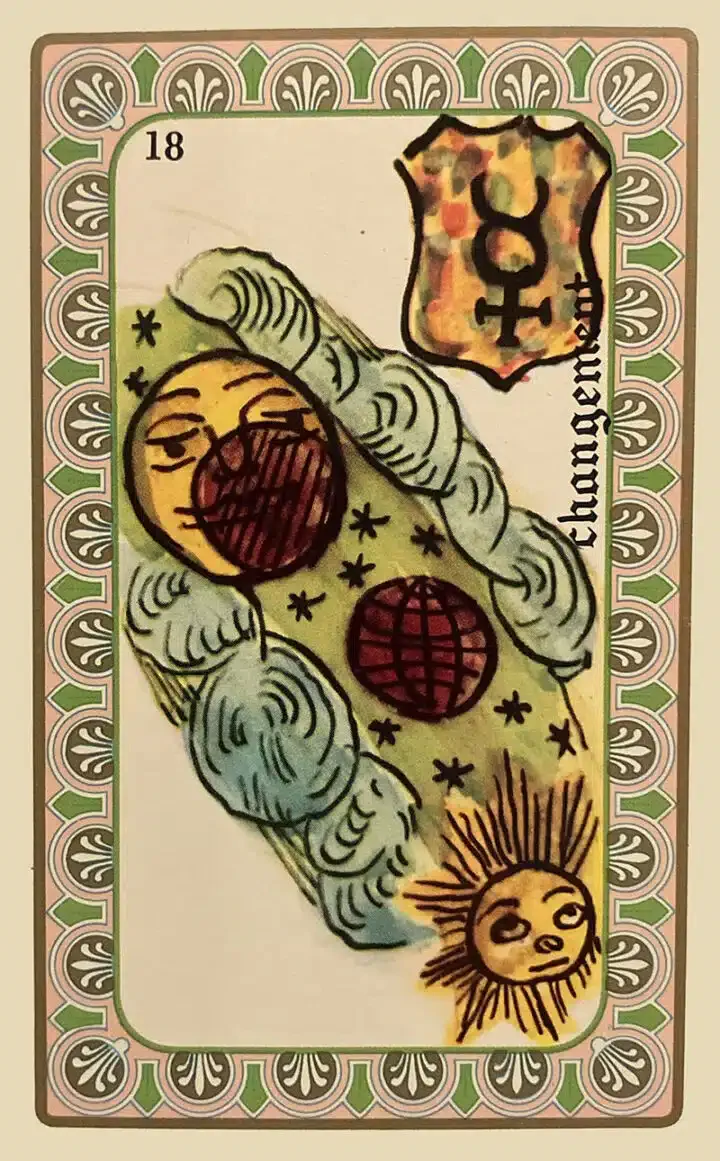
Belline · Card #18 · ♄ Saturn
Change — Belline
“The wheel turns, what was fixed becomes fluid, a new cycle begins in earnest”
Change belongs to Saturn (♄) — but here Saturn operates not in his restrictive, limiting dimension but in his capacity as the lord of cycles and the manager of time. Saturn rules what endures precisely because he also rules what passes: nothing lasts forever, and it is Saturn who marks the endings that make new beginnings possible. Change is Saturn as the great administrator of transformation — the planet ensuring that the cosmic order moves forward through its necessary stages. In many esoteric traditions, the Saturn-Change archetype corresponds to the Wheel of Fortune: the cosmic mechanism by which what rises must fall and what falls must rise. The Belline tradition inherits this understanding — Change is not random or capricious but structured, cyclical, and ultimately purposeful. What appears to be chaos is, at a higher level, the orderly rotation of phases within a larger pattern. This gives the card its essential ambiguity: Change is neither inherently positive nor negative. It is the announcement that a phase is ending and another beginning. Whether this is good or bad news depends entirely on what the ending phase contained — and what the querent has the wisdom and courage to do with the transition.
General Meaning
Change in a reading signals that a significant transition is either underway or imminent — one that will alter the querent's situation in a way that cannot be undone. This is not the minor adjustment or the cosmetic renovation, but the fundamental shift: a phase of life genuinely ending, a new one genuinely beginning. The card appears at genuine turning points: the end of a relationship that has run its course, the conclusion of a professional chapter, a move to a new city, a health change that reshapes daily life, the children leaving home, the retirement, the diagnosis that reorients everything. These are Saturnian events: weighty, real, and transforming. The precise nature of the change must be read from surrounding cards — Change itself identifies the fact of transition without specifying its content. What is changing? What is being left? What is coming? The neighbours in the spread answer these questions, while Change itself confirms that the transition is real and significant.
Positive aspects
In a positive position, Change signals liberation from a situation that has been constraining the querent. Whatever has been outgrown — a job, a relationship, a belief system, a way of living — is now being shed, and this shedding, however uncomfortable, will prove to have been exactly what was needed. The new phase arriving, though unfamiliar, carries genuine possibility. For querents who have been stuck — in depression, stagnant circumstances, or situations of prolonged difficulty — Change in a positive position is one of the most welcome cards in the deck. It says: this is moving. The stasis is ending. What feels permanent is about to shift.
Challenging aspects
When Change is surrounded by difficult cards, the transition being announced is unwanted, difficult, or painful. Something the querent values and wishes to preserve is ending — a relationship dissolving, a career disrupted, a lifestyle becoming unsustainable. The wheel turns whether the querent is ready or not. The challenge with Change in a difficult position is not to resist the transition but to navigate it wisely. Saturn rewards those who face reality honestly and act appropriately at turning points; he punishes those who cling to what is ending beyond the point where it was wise to hold on.
Meaning by Domain
Love
A significant shift in a relationship — moving from one phase to another (from dating to commitment, from partnership to dissolution, from distance to reunion). The specific direction is shown by surrounding cards. The relationship as it has been known is changing into something different.
Career
A major professional transition: career change, sector change, promotion to a different level with different demands, retirement, redundancy that opens a new path. The current professional chapter is ending; the next has not yet fully declared itself.
Health
Change in health status — for better or worse. A condition that has been stable is shifting; treatment is changing; recovery has begun; or a new health challenge is emerging. The card asks the querent to face the health reality honestly rather than hoping circumstances will remain as they are.
Spirituality
A genuine spiritual transformation — not the acquisition of new beliefs or practices but the fundamental reshaping of one's relationship with the sacred, with meaning, with mortality. The dark night of the soul and the emerging dawn that follows it.
Finances
A significant financial transition: change of income level, a major investment or divestment, financial independence reached or lost. Circumstances that have been financially stable are shifting — for better or worse according to surrounding cards.
Change in Combinations
Change amplifies whatever change is suggested by its companions. With Happiness (46), the change brings joy — a transition the querent will celebrate. With Ruin (52), the transition is toward loss — financial or structural collapse that must be faced. With Success (6), a positive turning point: the wheel has turned in the querent's favour and a new phase of achievement is beginning. With Destiny (2), the change is fated — it was in the cards from the beginning, and resistance would be futile. With the Blue Card (1), even in a difficult transition, protection operates — the querent will not be destroyed by the change. With Departure (13), the change manifests as literal movement or departure — a physical dimension is added to the transformation.
Key combinations
Historical Note
In classical astrology, Saturn was understood as the outermost visible planet — the boundary of the known solar system — and therefore the lord of time and limit. The ancient doctrine of the 'Great Year' and the Platonic year both operated within Saturn's temporal framework: history moved in vast cycles, empires rose and fell according to Saturnian rhythms, and the individual life was a miniature version of this cosmic pattern. Edmond de Grosmont's inclusion of Change in the Saturnian family reflects this deep connection between Saturn and the turning of ages. In the revolutionary and counter-revolutionary France of 1789–1848, change was not an abstract concept but a lived, violent, recurring experience — France had cycled through monarchy, republic, empire, and back again within living memory. A card named Change carried enormous resonance for readers and clients alike.
FAQ
Does Change always refer to something external, or can it be inner change?
Both equally. The transformation may be entirely internal — a change of perspective, values, or emotional orientation — even while external circumstances appear the same. Inner change often precedes and eventually produces external change.
Is Change ever a negative card?
It is never categorically negative or positive — it is the announcement of transition. Whether the transition is welcome depends entirely on what is changing and what the surrounding cards suggest about the direction and outcome.
How quickly does the change indicated by this card typically occur?
Saturn moves slowly in the sky — his transits are measured in years. But Change as a card often indicates a turning point that, once reached, moves relatively quickly. The preparation may have taken years; the actual shift happens over weeks or months.
What is the difference between Change and Departure in the Belline deck?
Departure is Mercury's card — swift, spatial, communicative. Change is Saturn's — weightier, more fundamental, less obviously directional. Departure is the act of leaving; Change is the transformation of state that leaving brings about. Both can appear together when a departure is genuinely transforming.
For an advanced reader: how does Saturn's sect (Diurnal) affect this card's interpretation?
Saturn is a Diurnal planet — he operates better in day charts, in conscious, public, and formally structured domains. Applied to Change, this suggests that transformations governed by this card respond best to conscious engagement: naming what is ending, making formal decisions, dealing openly with the transition rather than letting it happen passively. Saturn rewards those who bring discipline and intention to their turning points.