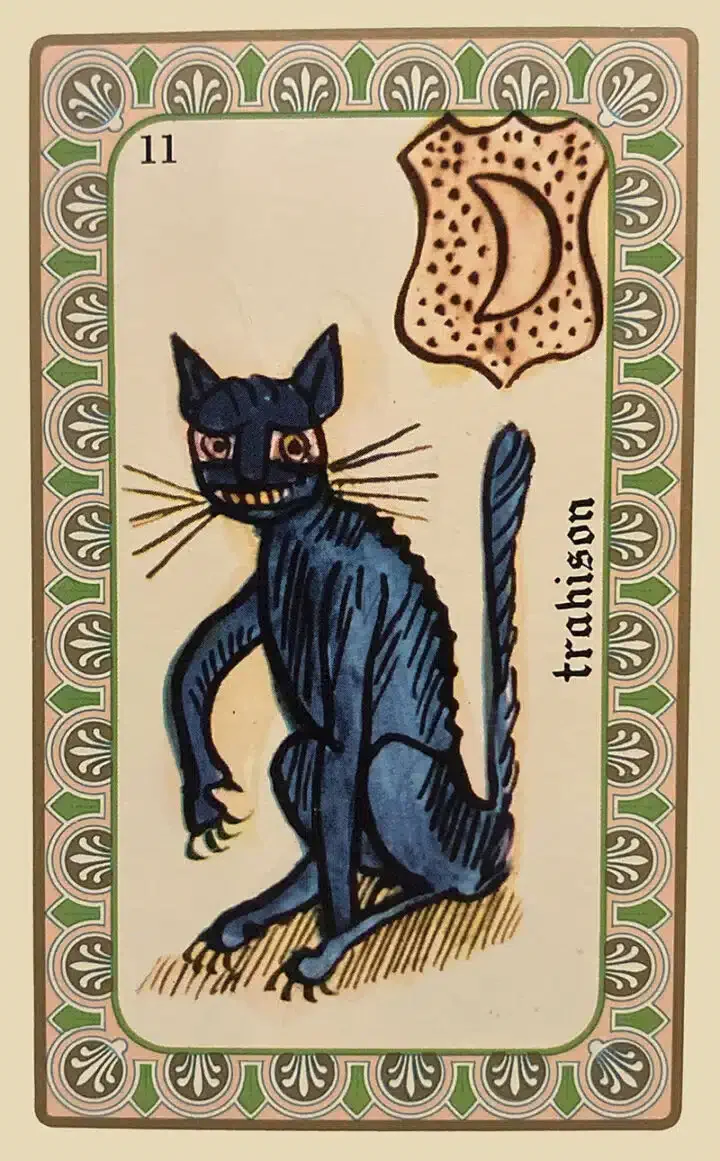
Belline · Card #11 · ♂ Mars
Betrayal — Belline
“Trust broken, hidden motives revealed, the painful clarity that follows deception”
Betrayal sits within Mars's (♂) domain in its most insidious form — not the open battle of Fire (38) or the explicit conflict of Enemies (36), but the wound delivered from behind, by someone close. Mars governs aggression and drive in all its forms; in this card, that martial energy has turned covert, infiltrating the spaces of intimacy and trust rather than attacking from the front. The traditional iconography associated with this card often includes a figure turning away, a gift being offered with concealed intent, or a handshake above a blade. These images capture the essential nature of betrayal: it requires proximity and trust to inflict its damage. A stranger cannot truly betray us — only those we have opened to can reach the places where betrayal cuts deepest. In the Belline system, this card also carries the constructive side of Mars: the eventual courage required to face what happened, name it clearly, and refuse to be reduced by it. Betrayal is painful, but it is also a clarifying force — it removes illusions that were costing the querent more than they knew.
General Meaning
The appearance of Betrayal in a reading signals that treachery is either present, recent, or imminent. Someone in the querent's circle — often someone trusted, perhaps even loved — is not acting in good faith. Their motives are concealed, their loyalty is conditional, and the querent's interests are not being protected as promised. In practical terms, this can manifest as a colleague who takes credit for another's work, a partner who is unfaithful, a friend who reveals private confidences, a business associate who exploits access to insider information, or a family member whose support is conditional on the querent's compliance. The specific form depends on surrounding cards and context. The card does not always indicate that the betrayal is conscious or malicious — sometimes people act from fear, self-interest, or unconscious patterns rather than deliberate cruelty. But regardless of intent, the effect is the same: trust has been broken, and the querent needs to know it. Crucially, Betrayal in a reading is not a sentence — it is intelligence. Knowing the landscape changes what the querent can do about it. The card may be arriving precisely in time to allow preventive action, or to validate a querent's instinct that something was wrong.
Positive aspects
In a reading where difficult cards are present, Betrayal can paradoxically mark a turning point. It signals that the deception is on the verge of being uncovered — that the querent's instincts are correct, that what they have been feeling or half-knowing is real. The revelation that follows, however painful, begins the process of recovery and realignment. In some positions, Betrayal actually points to the querent's liberation: they discover that a relationship or alliance they thought was essential was built on false foundations — and that without it, better and more honest connections become possible. The betrayer, by revealing themselves, does the querent the unintended favour of removing a bad actor from their life. In spiritual readings, the card can represent the betrayal of the ego by the deeper self — the moment when comfortable illusions can no longer be sustained, and genuine growth begins in their place.
Challenging aspects
At its most difficult, Betrayal indicates that the querent is currently in the midst of a situation where they are being actively deceived, exploited, or sabotaged by someone close. The damage may already be done, or may be building toward a moment of discovery. Either way, the querent must prepare for a painful confrontation with reality. In love readings, the card's most common meaning is infidelity or emotional deception — a partner who is not what they presented themselves to be. In career readings, it speaks of being undermined, having work stolen, being passed over in favour of someone who positioned themselves better through politics rather than merit. The card also warns against the querent's own potential for self-betrayal: ignoring their instincts, rationalising away evidence of dishonesty, or remaining in situations they know are wrong out of fear of the alternative.
Meaning by Domain
Love
One of the most significant warning cards in romantic readings. Indicates infidelity, emotional manipulation, or a partner whose self-presentation is dramatically inconsistent with their private behaviour. For those seeking love, it warns against a specific person whose flattery is designed to exploit.
Career
Workplace treachery: credit stolen, confidences betrayed to management, alliances that are secretly working against the querent. Political sabotage from a colleague who presents as friendly. Due diligence is essential before signing contracts or sharing strategic information.
Health
In health readings, Betrayal often points to a body that has been pushed beyond its limits by the querent's own demands — a form of self-betrayal. It may also indicate a misdiagnosis, a treatment that is not working as promised, or — rarely — a medical professional who is not acting in the patient's best interest.
Spirituality
The dark night of the soul. A spiritual teacher or community that is not what it claims. The moment when a belief system no longer holds. Betrayal in spiritual readings calls the querent to find what is authentically theirs — what remains when external authority is stripped away.
Finances
Financial deception: fraud, embezzlement, a business partner who is diverting funds, an investment that was misrepresented. The querent is advised to audit, verify, and not take anyone's word on financial matters without documentation.
Betrayal in Combinations
Betrayal is one of the cards that most dramatically shifts meaning depending on its neighbours. With the Blue Card (1), even in this difficult context, protection is present — the deception may be discovered before serious harm is done. Next to Enemies (36), the combination is serious: multiple adversaries acting in concert. With Lawsuit (33), legal action arising from a betrayal is indicated — perhaps the querent will need to seek legal remedy. Paired with Love (29), the classic reading is infidelity or emotional manipulation within a relationship. Beside Negotiations (37), it warns that a deal being finalized contains hidden traps — review every clause. With Wisdom (44), the combination is ultimately hopeful: the painful lesson of betrayal will yield enduring insight. The experienced reader always looks at what flanks this card: the betrayer's identity, the domain of the deception, and the eventual outcome can all be read from its companions.
Key combinations
Historical Note
In 19th-century French fortune-telling culture, which was deeply embedded in a society navigating rapid social upheaval, the Betrayal card carried enormous weight. Class boundaries were shifting; political allegiances changed with each regime (France cycled through monarchy, republic, and empire multiple times between 1789 and 1870); family fortunes rose and fell. In this context, trust was a genuinely precious and fragile commodity. Edmond de Grosmont's decision to assign this card to the Martian family reflects the classical understanding that Mars is the planet of conflict in all its forms. In the 19th-century French esoteric tradition, influenced by Eliphas Lévi and the emerging occult revival, Mars was understood to govern not just war but all forms of assertion and violation — including the violation of the social contract that trust represents. Betrayal is therefore Mars at his most civilizationally corrosive: the force that undoes societies and intimacies from within.
FAQ
Does Betrayal always mean someone is cheating on me romantically?
No — that is one of its meanings, but betrayal takes many forms. In a career spread it points to professional treachery; in a financial spread, to fraud or misrepresentation; in a family spread, to divided loyalty or secret-keeping. The domain of the betrayal is indicated by surrounding cards.
If Betrayal appears, is it already too late to act?
Not necessarily. The card may be appearing as warning rather than confirmation. Look at its position in the spread: in the 'present' position it describes something currently unfolding; in the 'future' position it is a warning you still have time to act on; in the 'past' position it explains why a situation feels poisoned.
Can Betrayal refer to self-betrayal?
Absolutely — and experienced readers treat this as the card's deepest dimension. Ignoring your instincts, abandoning your values for short-term gain, staying silent when you should speak — all of these are forms of self-betrayal this card can address.
Mars governs both Betrayal and Fire (38) — what's the distinction?
Fire is Mars in open, externally-directed conflict: confrontation, accident, crisis that erupts into the visible world. Betrayal is Mars in hidden, internally-directed conflict: the covert strike, the slow erosion of trust, the damage done in private before the explosion. Both are Martian, but one is frontal and one is insidious.
How should a reader handle a client's emotional reaction when this card appears?
With precision and care. Name what the card is showing without dramatising it. Focus on empowering the querent — this is information they can act on. Avoid making confident claims about specific individuals ('your partner is cheating') and instead describe the energetic pattern ('there is deception active in this relationship') so the querent can apply their own knowledge to what the card reveals.